

40 Years of High-Altitude Rescue in Jena
The Jena Professional Fire Department’s High-Altitude Rescue Unit celebrated its 40th anniversary on Friday, August 28, 2026. The anniversary celebrations focused on the development of Special Rescue from Heights and Depths (SRHT), professional exchanges with high-altitude rescue teams from Thuringia, and a planned rappelling event at the JenTower.
Representatives from the Jena Professional Fire Department, as well as high-altitude rescue teams from Gera, the Ilm District, and the Thuringian Mountain Rescue Service, gathered for the anniversary. The program provided an opportunity to share experiences, showcase modern equipment, and look back on four decades of high-altitude rescue in Jena. A series of photographs, along with a comparison of past and present operational techniques, vividly illustrated how the equipment and working methods of the special rescue teams have changed since their inception.
The rappelling event at the JenTower, planned as a public highlight, could not take place due to weather conditions. It is scheduled to be rescheduled in the near future.
“High-altitude rescue is not a skill reserved solely for particularly spectacular operations. In a city like Jena, with high-rise buildings, industrial facilities, construction sites, and hard-to-reach areas, we must be able to rescue people safely even in places where standard rescue equipment reaches its limits. The fact that the professional fire department has possessed this expertise for 40 years is the result of continuous training, technical advancement, and a high level of personal commitment from our colleagues. Twenty-eight high-altitude rescue specialists maintain this specialized qualification in addition to their regular duties in the fire and rescue services. “They deserve our heartfelt thanks for this,” said Mayor and Head of Public Safety Benjamin Koppe.
Operations and Training
High-altitude rescue is deployed whenever people need to be rescued from heights, depths, or hard-to-reach areas and conventional rescue routes or equipment are insufficient. These include, among others, high-rise buildings, cranes, construction sites, industrial facilities, and shafts.
The team is called to approximately 30 to 40 operations each year. Due to the unique locations and the specialized rescue equipment required, each of these calls presents specific challenges. Only the combination of specialized rope and safety techniques and highly qualified rescue personnel makes it possible to reach, secure, and safely rescue people even in hard-to-reach locations.
High-altitude rescue training takes place every Thursday. During these sessions, the team practices a wide range of possible scenarios and generally remains on standby. If an emergency call comes in, the training must be paused or stopped entirely.
Every active high-altitude rescuer must complete at least 72 hours of training per year. This additional training takes place alongside their regular duties in the fire and rescue service. These include, for example, responding to calls in an ambulance, operating the turntable ladder, and working in the dispatch center or on hazardous materials incidents.
The specialized team currently comprises 28 responders, divided among the three shift units—two with ten members each and one with eight. Each shift unit has two specially qualified instructors on staff.
“Teamwork is crucial. Every move must be precise, every safety system must function reliably, and every decision made during an operation must be sound. This requires regular training, a high level of technical expertise, and a great deal of mutual trust. What our colleagues accomplish deserves great recognition. Without their specialized knowledge and high level of readiness, the approximately 30 to 40 special rescue situations that occur each year could not be safely managed. This special unit is indispensable to the Jena Fire Department. “I am proud of this team, and this anniversary is the perfect occasion to express my heartfelt thanks,” emphasizes Nick Ludwig, Head of Specialized Services for the Fire Department.
High Demands on the Specialized Team
Anyone who wants to join the high-altitude rescue team must possess not only physical fitness and a complete lack of fear of heights but also a high level of mental resilience. Equally important are a sense of responsibility, the ability to take criticism constructively, openness, and the capacity to act independently, safely, and reliably even over extended periods.
In addition, quick comprehension, a willingness to innovate, and practical knowledge of work areas with a risk of falls are advantageous. Experience in mountain rescue, industrial climbing, tree care, or comparable fields can serve as an important foundation.
Technology and Tactics in Flux
Among the greatest changes of the past 40 years are technical equipment and the associated operational tactics. While safety systems used to be made in part directly from ropes, rescue teams today have access to modern safety harnesses and numerous specially developed rescue and safety devices.
New materials have made the equipment lighter and, at the same time, more durable. The range of technology available for rope-assisted work, mountain and high-altitude rescue, and industrial climbing has also grown significantly. As a result, rescue teams can now select the system best suited to each situation from a wide variety of specialized options. One essential fundamental element, however, has not changed: The knots used have remained the same to this day.
Thanks to Our Supporters
Special thanks go to the Saller Group, as the owner, and to the JenTower management team for their excellent cooperation. At 159.60 meters, the JenTower is the tallest office building in the new federal states and a landmark of Thuringia visible from afar. The tower provided an extraordinary setting for the anniversary celebration. The comprehensive support provided during the preparation, execution, and planning of the abseiling event contributed significantly to the success of the anniversary celebration.
The event was also supported by the City of Jena, as well as by TEAG and Hornbach. TEAG supported the Jena Professional Firefighters’ Association with a monetary donation, while Hornbach provided an in-kind donation. The Jena Fire Department thanks all participants and supporters for their commitment.
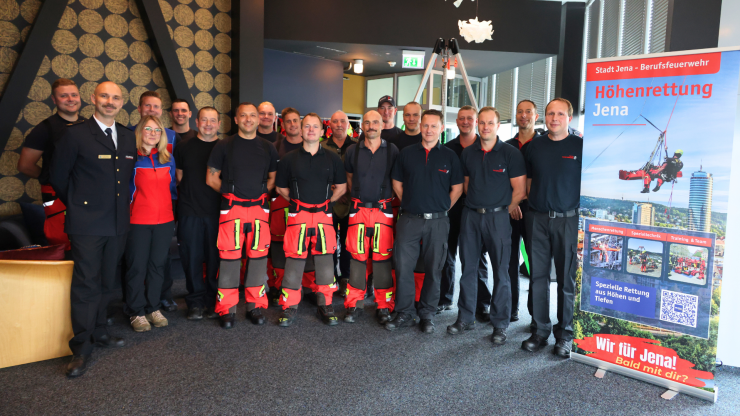
Nick Ludwig, Fachdienstleiter Feuerwehr (2. v. l.), und Martin Sommer, Leiter SRHT (vorn in der Mitte), feierten gemeinsam mit dem Team und den Gästen im JenTower das 40-jährige Bestehen der Speziellen Rettung aus Höhen und Tiefen.
© Stadt Jena