

Control centers in Eastern Thuringia plan joint emergency call structure
Last Thursday (30.01.2025), the regular meeting of the East Thuringia control center network took place in Gera, which was attended by Gera's Lord Mayor Kurt Dannenberg (CDU) as well as the district administrators from the Saale-Holzland district, Johann Waschewski (CDU), from the Altenburger Land, Uwe Melzer (CDU), and from Saalfeld-Rudolstadt, Marko Wolfram (SPD). Other representatives from all districts and the East Thuringia Rescue Service Association were also present. The aim of the meeting was to discuss the progress of the state project as well as future opportunities and challenges for the Thuringian control centers.

Die interkommunale Zusammenarbeit mit regelmäßigen Arbeitstreffen ist ein wesentlicher Bestandteil der Sicherheitsarchitektur Ostthüringens.
© Stadt Gera/Göran Kugel
The originally planned structural reform, which envisaged reducing the 13 existing control centers to six, could not be implemented. Nevertheless, the regional authorities in Eastern Thuringia have reaffirmed their support for the state project and are actively working on the planned partner model "PiLOT.112" despite the current lack of funding guidelines.
"The East Thuringia control center network is playing a pioneering role in the Thuringian control center reform. With the draft of the new funding guideline and the amended legal requirements, all Thuringian control centers are under pressure. These stipulate that the reform must be implemented by the end of 2030. Although we reacted immediately after the introduction, this target is an unachievable timeframe even for us," explains Gera's Lord Mayor Kurt Dannenberg and called for the funding guideline to be adopted quickly: "We have already geared our planning towards the financial support of the Thuringian Ministry of the Interior and hope that we will not be left in the lurch."
The "PiLOT.112" partner model is intended to optimize the 112 emergency number in Eastern Thuringia by meeting modern standards for control centres and KRITIS requirements, ensuring a high quality standard, guaranteeing mutual representation and redundancy and providing support during periods of high demand due to overflowing emergency calls. In addition, the implementation of a joint operations control and communication system and the use of digital radio under a common wireline connection are planned. Other joint objectives include the development of technical and economic innovations and the improvement of the "control center" employer brand.
The project design and the special-purpose agreement between Gera and Jena have already been successfully drawn up, but feedback from the state of Thuringia is still pending. The special purpose agreement forms the basis for cooperation between the central control centers in Jena and Gera as part of the state project and covers the implementation of phase 1 (partner model) and preparation for phase 2 (state-wide network), including compliance with the criteria of the funding guideline and the framework specifications.
The East Thuringia control center network has become firmly established in recent years and has intensively supported the state project on the control center structure. The two regional control centers currently coordinate the ground-based rescue service as well as fire and assistance operations for around 700,000 citizens in the five districts of Eastern Thuringia and the cities of Jena and Gera. Inter-municipal cooperation with regular working meetings is an essential part of the security architecture of Eastern Thuringia.
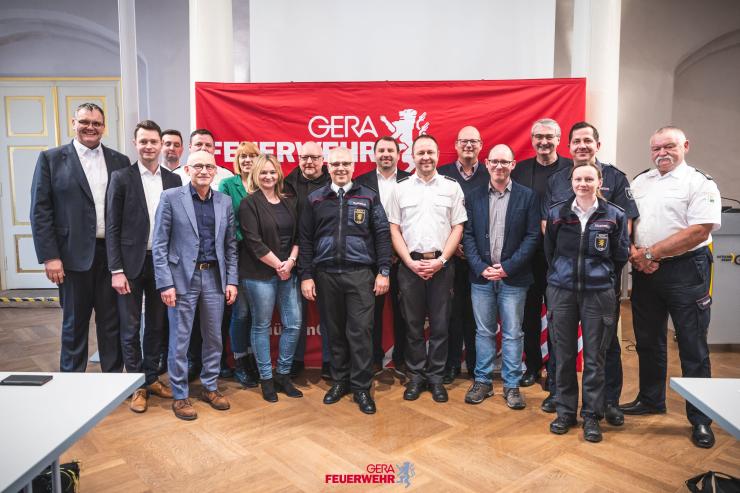
Der Leitstellenverbung Ostthüringen tagte in Gera, um die gemeinsame Notruf-Struktur zu optimieren.
© Stadt Gera/Göran Kugel