

Day of Remembrance for the Victims of National Socialism 2024
Ladies and Gentlemen,
Just over two weeks ago, the research platform Correctiv published information about a meeting of high-ranking AfD politicians, neo-Nazis and financially strong entrepreneurs in a hotel near Potsdam in November last year. They planned nothing less than the expulsion of millions of people from Germany, people with a migration background, people with German citizenship.
Several AfD politicians then tried to play down the dimensions of the considerations and thought experiments, pointing out that the AfD has long pursued the goal of deporting and expelling people and that this can be found in the party manifesto.
This trivialization is what is actually frightening. This is where the party reveals its true face by not even seriously or even convincingly attempting to distance itself from such inhumane considerations. Even people who have German citizenship and do not fit into the AfD's value system can no longer be sure that they are allowed to live in this country.
Since last weekend, a wave of protest demonstrations involving hundreds of thousands of people has been rolling through the country.Here in Jena, too, I estimate that there were far more than the three and a half thousand people reported by the police. It is like an awakening of society, which is willing to hold on to democratic and humanistic values.
The fact that the thought experiments on the mass deportation of people with a migration background are leading tens of thousands of people to take to the streets in protest makes me happy and confident. But we all know that this is far from a victory.
The real tests are yet to come with the upcoming elections and the results we will have to deal with afterwards.
It is important that we continue to incorporate the knowledge of what has happened in the past into the current debate about our future. That is why I am glad that we have come together here today for our annual commemoration of Holocaust Remembrance Day, the day on which the Auschwitz-Birkenau concentration camp was liberated.
The "Day of Remembrance of the Victims of National Socialism" has been observed in Germany as a day of remembrance since 1996 and serves to remember all victims of the Nazi regime: Jews, Christians, Sinti and Roma, people with disabilities, homosexuals, political dissidents as well as men and women of the resistance, scientists, artists, journalists, prisoners of war and deserters, forced laborers - the millions of people who were disenfranchised, persecuted, tortured and murdered under National Socialist tyranny.
At the end of 2005, the United Nations General Assembly declared January 27 the "International Day of Commemoration in Memory of the Victims of the Holocaust". It has been observed worldwide since 2006.
Next May marks the 79th anniversary of the end of the Second World War and the end of the National Socialist regime in Germany. It has been more than three quarters of a century since the cruelest war - in terms of the number of victims and the countries and regions of the world involved - and an unimaginable machinery of extermination against people came to an end.
On the way to this end was the liberation of the Auschwitz-Birkenau concentration and extermination camp, the camp that has come to epitomize the Holocaust.
The systematic approach of the National Socialist regime with the aim of completely exterminating the Jewish people became clear once again when, in recent days, apparent parallels were drawn between the secret meeting in a hotel villa by the lake in Potsdam and the Wannsee Conference on January 20, 1942.
The political decision on the so-called "final solution to the Jewish question" had long since been made and the focus was now on the organization in detail and the coordination of the cooperation between the authorities involved, the ministries and offices and the SS in the state apparatus.
The protocols show in detail how many Jews from a total of 30 countries and territories throughout Europe were to be exterminated, 11 million people in all.
The people captured throughout Europe, mostly Jews, were transported to Auschwitz-Birkenau by rail. The countries of origin included Germany, Belgium, France, Greece, Italy, Yugoslavia, Luxembourg, the Netherlands, Austria, Poland, Romania, the Soviet Union, Czechoslovakia and Hungary.
The death toll in this camp amounted to around 1.1 million people, approximately one fifth of the total of 5.6 million Jews murdered.
Among those murdered in Auschwitz were around 160,000 non-Jewish victims, mainly Sinti and Roma, Poles and homosexuals. 900,000 people were murdered in gas chambers immediately upon arrival, while a further 200,000 died from illness, malnutrition, abuse, medical experiments or forced labor.
Between January 17 and 23, 1945, around 60,000 more prisoners were "evacuated" by the SS, i.e. some were shot and most were driven west on death marches. Then, on January 27, 1945, the prisoners remaining in the camp were liberated by Soviet troops of the 322nd Infantry Division of the I Ukrainian Front. Despite medical assistance, many of the approximately 7,000 surviving prisoners died in the following days.
When we come together today, there is no one among us who experienced the dictatorship of National Socialism for themselves or was even a victim of this regime. Almost 80 years after the end of the Second World War, the opportunity is closing for survivors to tell us directly about their experiences.
However, it will remain the case that individual fates handed down to us make the suffering that took place accessible and comprehensible, perhaps even understandable. Being personally affected can strengthen us against the danger of a repetition of what happened back then and against new, present-day forms of inhumanity.
Around 700 victims of the National Socialist dictatorship have been mourned in Jena: Jews, Sinti and Roma, people with disabilities, dissidents, homosexuals, forced laborers and others. The Jena Memorial and Book of the Dead on the city's website is a virtual memorial to the local history of the victim groups, which primarily serves the purpose of coming to terms with the past.
But people in Jena, as elsewhere, need real places to pause and remember, and they have created several of these places. The memorial here on the Heinrichsberg was erected in 1948 and was one of the first in Thuringia.
Information and remembrance of the death march through Jena has come to the fore again in recent years with the stele at the Camsdorf Bridge, the redesign of the grave of the murdered prisoners at the East Cemetery and the new stele to Robert Büchler, the survivors, near the Angergymnasium.
Since 2007, Stolpersteine have also been laid in our town, now well over 50 in number, making it particularly clear that the victims were citizens of this town and possibly neighbors of our ancestors. After the "Sound of the Stumbling Stones", people meet every year on November 9 at Westbahnhof, where the memorial plaque has commemorated the Jews, Sinti and Roma deported from there since 1988.
There is a memorial stele in Löbstedter Straße in memory of the Jews interned there and the Jena subcamp, and a plaque in the town hall arcades commemorating the 60 Jena victims of medical crimes in Pirna-Sonnenstein.
The list could go on and on. It's good that these places exist. They are an expression of the city's culture of reappraisal and remembrance as well as the deep involvement of the city and its people in the crimes of the National Socialists.
The commemoration of the victims of National Socialism must always include the question of how the murderous acts came about and who bears responsibility for them. Victims always include perpetrators. Jena's victims include Jena's perpetrators. The perpetrators were not simply "the SS", "the camp guards", "the National Socialists" or "the Wehrmacht".
The perpetrators in Jena were often - like the victims - citizens of this city, possibly neighbors of the victims, neighbors of our ancestors or even our ancestors themselves.
The perpetrators worked in the city administration, in municipal and private companies, in the university, in hospitals, in organizations and associations. The perpetrators in the offices, the employees of the local administration also made industrialized murder possible.
Just as the Wannsee Conference was organized at the highest level, it was compliantly implemented down to the lowest level. There are still many unanswered questions regarding the administration in Jena; the process of coming to terms with the past has not yet been completed.
Our commitment to safeguarding our democratic social system and our civic and humanist values is needed more than ever. Today, we are not a thoroughly organized dictatorship, but a liberal and stable democracy. However, 100 years ago, the National Socialists also gathered on the fringes of society and then penetrated the center. This must not happen again today.
The parallels that broad sections of the population see in the two meetings, the Wannsee Conference and the meeting last November, should not be underestimated.
Then, as now, it was about a völkisch vision of a pure white society. Back then, the mass murder was organized, now there was talk of the mass deportation of unwelcome population groups.
We must not forget the events and crimes of National Socialism and the Second World War. It takes our efforts and our awareness to stand up for human rights and human dignity in our daily actions. They are the basis for a peaceful coexistence of mankind. Let us act together here!
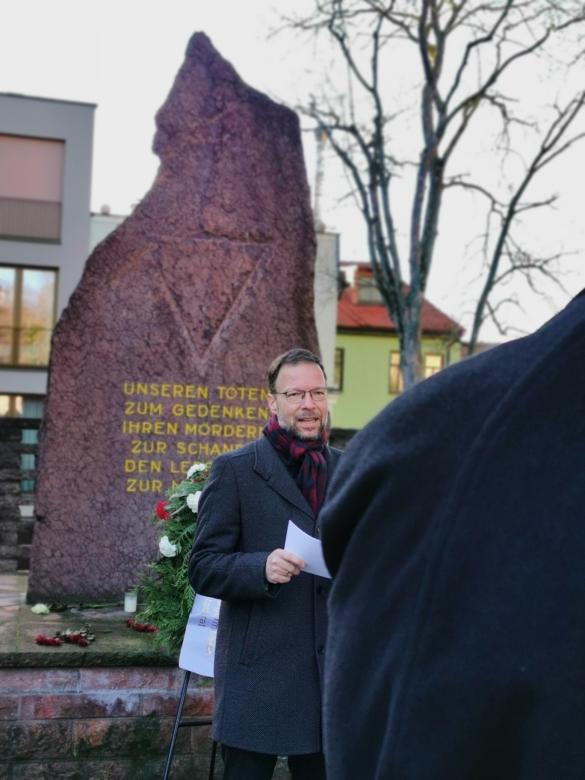
Oberbürgermeister Dr. Thomas Nitzsche
© Stadt Jena