

Jena can score points in the location competition for the future center
At a press conference today (29.06.2022), Lord Mayor Thomas Nitzsche presented the Jena project team for the application for the "Future Center for European Transformation and German Unity". He made it clear:
"The city of Jena has the best prerequisites in the location competition for the future center - both in comparison with cities in other federal states and in a Thuringia-wide comparison. The state of Thuringia should get behind the most promising applicant city as quickly as possible in order to convince the jury to bring the Future Center to Thuringia."
Key locational advantages speak for Jena as the Thuringian location for the Future Center
Thomas Nitzsche referred to Jena's key locational advantages, with which the city can score points in the application for the Future Center.
"As a city, we can offer a consistent story and narrative of successful transformation: We saw the city undergo its first major transformation when it was founded in the 16th century. Around 1800, we were the intellectual center of Europe with the Romantics, Hegel, Schiller and Goethe. In the 19th century, Ernst Abbe, Carl Zeiss and Otto Schott wrote industrial history in Jena and laid the foundations for the things that are still at work in Jena today: the close links between the city, business and science and a strong civil society, which made it possible to emerge from central upheavals into a successful post-reunification development."
The cooperation between the city and the surrounding area, which is now also anchored in municipal working groups, Jena's leading role in citizen participation projects, the active processing of the consequences of transformation - as exemplified by the NSU complex and the nationwide "Kein Schlussstrich" project - and not least the numerous international networks and collaborations in business and science speak for Jena as a location for the future center. The city can offer a varied stay to the up to one million visitors expected each year. Science (German Optical Museum, ZEISS Planetarium), culture (theater, museums, Jena Philharmonic Orchestra) and nature (Saale cycle path, water sports, hiking) are combined at a very high level in Jena. Last but not least, Jena also has an attractive building site in the heart of the city - Eichplatz - which could be home to the future Future Center. Jena can meet all of the 13 known tender criteria for the application for a future center. One criterion - a university with a social science focus - is of central importance.
The city of Jena is therefore applying for the future center together with the high-performing and excellent University of Jena. Katja Bär, Head of University Communications at the University of Jena and a member of the application team, said:
"The Friedrich Schiller University Jena is one of the leading centers of transformation research not only regionally, but throughout Germany and Europe. Our outstanding expertise in the social sciences and humanities is based not least on a comprehensive international network, particularly in the countries of Eastern Europe. At the same time, the University, with its international students, employees and guests, plays a key role in shaping Jena's character as a cosmopolitan, diverse and future-oriented city. The scientific expertise, the international networks and the close connection with the city make Jena the most suitable location for the Future Center. "
Powerful team of applicants for the Future Center in Jena
Jenais entering the application phase with an interdisciplinary project team. Christine Schickert is pulling the strings. She is Scientific Director of the Collaborative Research Center Structural Change of Property at the University of Jena and is leading the project together with Martin Fischer from the Central Project Management of the City of Jena. The content of the application concept will be developed in four working groups (WG). A high-caliber advisory board also provides important impulses and advice for the Jena bid concept. The advisory board includes Prof. von Puttkammer, Chair of Eastern European History and Co-Director of the Imre Kertész Kolleg, Wolfgang Tiefensee, Thuringian Minister for Economics, Science and Digital Society, Dr. Ute Lorenz, President of the Klassik-Stiftung Weimar and Prof. Lessenich, Director of the Institute for Social Research at Goethe University Frankfurt.
Together with renowned representatives of the University of Jena, the Science Working Group will shed light on what the term transformation means and how it can be distinguished from other concepts and theories. How societies, experiences and interpretations of transformation intertwine was recently discussed in a symposium with scientists.
Axel Salheiser, Director of the Institute for Democracy and Civil Society and member of the Science Working Group, said:
"It is not only in East Germany that the transformation processes after 1989 continue to shape political culture, economic and social structure, demographic development, the social situation and people's everyday lives to this day. The profound social change has been inscribed in people's experiences and is reflected and interpreted in very different ways. We are only just beginning to understand exactly what the long-term consequences will be, what problems and contradictions will arise and what similarities and differences exist between countries. In view of the current challenges, this also raises the question of the future of peace and democracy in Europe. The ZET will therefore also explore the paths along which our society will develop in the coming decades."
The Working Group Gallery of Transformation and Unity represents the pillar of culture on which the "Center for European Transformation and German Unity" is to be built. Dr. Christian Faludi, who heads the working group and is also project manager of the Society for the Study of the History of Democracy, outlines the tasks of the working group:
"The Future Center will change Jena and its surrounding area. However, it is not intended to give the city another classic-style museum. The citizens have clearly conveyed this message to us. Not least for this reason, it is our incentive to create a place characterized by innovation, which itself always remains changeable and can always change. The result will be an inclusive space that enables people from all countries to get involved and experience their own transformation. Jena offers the best conditions of all the applicant cities for such a project."
A key feature of the Future Center is that it is intended to be a place for encounters and dialogue between citizens, politicians and other stakeholders. Formats and ideas for this are being developed in the dialog and meeting working group. The application phase itself is also taking place with citizen participation.
Tobias Schwessinger from the Research and Transfer Service Center at the University of Jena, who is involved in the working group together with Tilo Schieck from the Thuringian Archive of Contemporary History, says of the work:
"The Future Center will be an open space for the citizens of Jena, Germany and the whole of Europe. A place where we can discuss past and future transformations together. A place that is brought to life by the people and the participation of the citizens. With its active civil society, Jena offers the ideal conditions for this. Jena's bid is not a bid by the city administration, it is a bid by the people who live here and who are convinced that the future center of Jena would benefit the most."
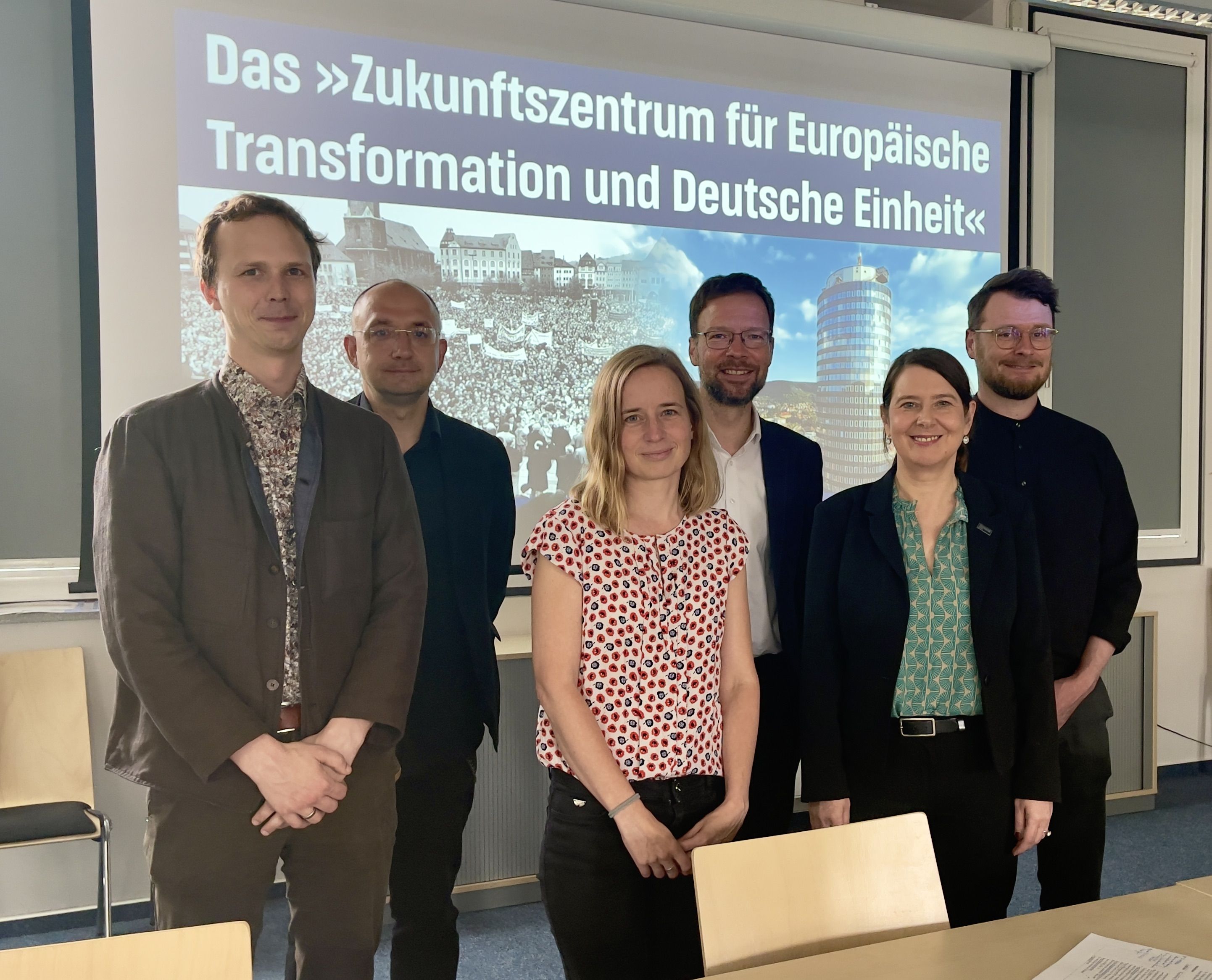
Foto: Stadt Jena
Background
The Future Center for European Transformation and German Unity will be a place where science, society and culture jointly address the transitions and ruptures before and especially after the years 1989/1991 in Germany and the countries of Eastern Europe. The combination of a lively and inviting exhibition and cultural space, an academic institute - with a graduate college and fellowship program - and an open dialogue and meeting center will provide a protected place where experiences of upheaval and change can be shared, researched from a specialist perspective and communicated in an innovative way. The center is to be built in an eastern German city following an open tender, with the federal government providing extensive funding for construction (200 million euros) and ongoing operations (approx. 45 million euros per year). Around 200 people are to be employed at the future center of the future.