

Jena Climbs in the Digital Ranking
Jena has made a significant leap forward in the nationwide Smart City Index compiled by the digital industry association Bitkom: The city has moved up seven spots and, with a score of 73.0 out of a possible 100 points, ranks 47th among the 83 major German cities surveyed. Among cities with 100,000 to 149,999 residents, Jena ranks 5th.
The Smart City Index shows how far digitization has progressed in major German cities. To this end, Bitkom considers not only individual digital offerings but also the cities’ development across various areas. The assessment covers public administration, energy and the environment, mobility, IT and communication, as well as society and education. Factors included in the evaluation are, for example, digital public services, digital infrastructure, smart mobility solutions, data applications, and digital opportunities for education and civic engagement.
The study examined all German cities with at least 100,000 residents. The index scores are based on verifiable information provided by the municipalities and publicly available data sources. All 83 cities examined were able to provide their own data and substantiate it with sources—an option that all cities took advantage of.
More Than Just a Ranking: Why This Is Important for Jena
“Moving up seven spots to fifth place among cities of our size sends a strong signal. It shows that Jena is making progress in digitalization and that our projects and investments are increasingly reflected even in a nationwide comparison. For us, however, the ranking itself is not the actual goal. What matters most is that digitalization reaches people, makes everyday life easier, and at the same time creates favorable conditions for a modern hub of science and business,” says Benjamin Koppe, mayor and head of the Department of Digitalization for the City of Jena.
The Smart City Index is more than just a ranking. It provides nationwide visibility and comparability regarding how cities are positioned on key issues of digitalization. For Jena, the index thus offers an important outside perspective: Where do our strengths lie, where is there still room for improvement, and where can the experiences of other cities serve as a guide?
At the same time, many of the factors examined directly impact a city’s attractiveness. A high-performance digital infrastructure, modern administrative services, mobility, educational opportunities, and an innovation-friendly environment are relevant not only to citizens but also to businesses, academia, skilled workers, and cooperation partners.
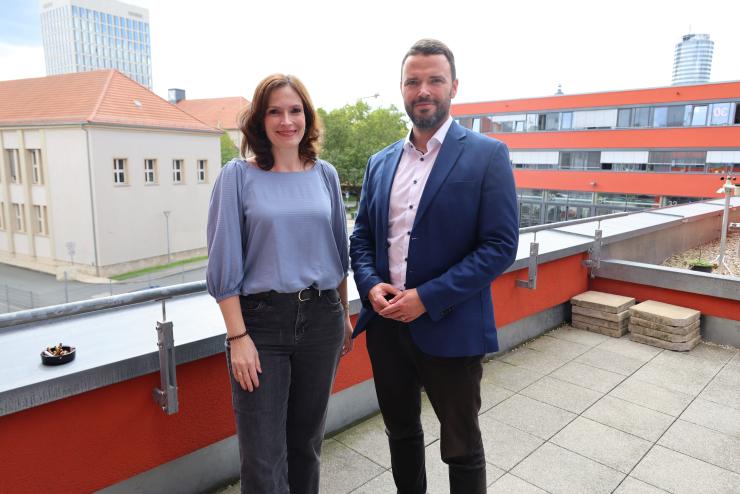
Grund zur Freude bei Dorothea Prell, Gesamtprojektleiterin Smart City, und Bürgermeister und Digitalisierungsdezernent Benjamin Koppe: Jena verbessert sich im Smart City Index 2026 um sieben Plätze und erreicht in seiner Größenklasse Rang fünf.
© Stadt Jena
The Smart City Index is not a traditional economic or business location ranking. It highlights how well a city is positioned in terms of key digital framework conditions. This outside perspective is therefore particularly important for Jena as a hub for science, business, and technology.
Strengths in Society and Education
Jena performs particularly well in the Society and Education category. With 86.3 points, the city ranks 23rd nationwide in this category, improving by twelve positions compared to the previous year. The assessment takes into account, among other factors, the digitization of schools, digital literacy, the local digital scene, startup ecosystems, coworking spaces, and opportunities for digital participation.
In the Mobility category as well, Jena achieved a score of 77.1 points, which is above the overall average. In the area of public administration, the city scored 75.9 points, and 72.0 points in IT and communication. The index indicates room for improvement, particularly in the area of Energy and Environment, where Jena scored 53.5 points.
How Digitalization Is Taking Shape in Jena
Jena’s strong performance also reflects a continuous digital transformation that is evident in many parts of the city. The Jena Smart City project plays a key role in this effort.
The urban data platform “WISSENsAllmende” is creating a municipal data infrastructure through which information can be aggregated, linked, and made available for various applications. The measurement of pedestrian traffic in the city center exemplifies how data can help better understand the use and changes in public spaces, thereby laying new foundations for urban development and planning.
Equally important is the question of how digitalization is received by the public. Through personalized advice, courses, and open-access programs, the “ProbierLaden” at Engelplatz has become a highly sought-after resource for digital inquiries. The JEDI at Postcarrée, in turn, creates a space for innovation and knowledge transfer. Here, the city’s community, the digital economy, academia, startups, and young talent come together in workshops, hackathons, and other formats to learn about new technologies, develop concrete use cases, and strengthen collaboration among different stakeholders.
These four examples also illustrate the breadth of Jena’s smart city approach: from data and digital infrastructure to data-driven urban development, and on to education, participation, and innovation.
“A ranking can only ever reflect a snapshot of development. What matters most to us is what lies behind the numbers: Are solutions emerging that can be used in the long term? Are we reaching diverse groups of people? And are we actually succeeding in integrating digitalization into everyday city life? Projects like the WISSENsAllmende, the ProbierLaden, and JEDI make exactly that tangible,” says Dorothea Prell, Smart City Coordinator and Overall Project Manager for the City of Jena.
Both Confirmation and Incentive
The result should be viewed with a sense of perspective when compared to previous years. The Smart City Index survey has been refined in recent years. Consequently, the questions, criteria, and data sources are not identical across all years. The city’s improved ranking therefore cannot be interpreted solely as a change in its actual digital performance.
For Jena, however, the result is both confirmation and motivation: The ranking shows where the city stands in a nationwide comparison, highlights its strengths, and at the same time points to areas where further development is needed.
The city therefore intends to continue driving digitalization forward, paying particular attention to ensuring that digital solutions create tangible added value for citizens, the administration, the business community, academia, and urban society.