

Jena Fire Department in Ohrdruf
Mayor and Head of Public Safety Benjamin Koppe, along with Nick Ludwig, Head of the Jena Fire Department, visited the training camp for the current basic firefighter training course at the Ohrdruf military training area. The one-week hands-on training on the sprawling 4,287-hectare site is one of the most demanding phases of the six-month basic training course and is designed to reinforce the skills acquired so far under conditions that are as close to real-life situations as possible.
On April 1, 2026, the 9th basic training course for the fire service began in Jena. A total of 16 participants from Jena, Thuringia, Berlin, and the private sector are currently completing their training with the Jena Fire Department. In addition to the city of Jena, participants represent the cities of Berlin, Rudolstadt, Nordhausen, and Ilmenau; the South Thuringia Emergency Medical Services Association; and the company TotalEnergies from Leuna.
The current basic training course comprises approximately 980 instructional hours and combines theoretical fundamentals with intensive practical exercises and physical fitness training. The training curriculum includes, among other things, firefighting and extinguishing techniques, technical rescue in traffic accidents and complex emergency situations, rescue and first aid, hazard awareness and legal fundamentals, vehicle and equipment training, radio and operational communications, self-contained breathing apparatus training, endurance exercises, and tactical procedures during operations.
Benjamin Koppe emphasizes the importance of hands-on training: “The military training area offers ideal conditions for training for emergency situations under realistic conditions. Whether it’s firefighting, technical rescue, rescuing people trapped under debris, or fighting wildfires in cooperation with the Thuringia Police Helicopter Squadron. Here, the trainees gain important experience for their future operational duties. It is precisely these kinds of exercises that build the necessary routine and confidence so that every move is executed perfectly in an emergency.”
During the visit, one of the main focuses was a wildfire drill conducted jointly with the Thuringian Police Helicopter Squadron. For this purpose, a controlled fire was set using straw on the training grounds. The firefighters practiced assessing the situation, fighting the fire on the ground, and coordinating with the police helicopter. The helicopter supported firefighting efforts from the air, using a water tank with a capacity of approximately 900 liters.
“It’s not a given that we can use these conditions for training. That’s why I’d like to thank the German Armed Forces for the opportunity to train on the grounds, and the Thuringian Police for their excellent cooperation,” added Koppe.
At the Ohrdruf military training area, participants deepen their understanding of the basic training curriculum under conditions that closely mimic real-world scenarios. Training includes, among other things, fires in buildings and outdoors, traffic accidents with trapped individuals, the rescue of people buried under debris, as well as search and rescue operations both day and night. Extinguishing fires at night and maintaining operational readiness despite physical and mental stress are also part of the training week.
It’s not just about mastering individual techniques with confidence. The trainees must learn to remain operational even under stress, take on responsibility, and rely on one another as a team. Especially as physical and mental exhaustion sets in, a crucial part of the training begins: pushing through when things get tough and remaining capable of acting together.
The week in Ohrdruf is deliberately designed to be intensive. It brings together many training topics that were previously taught separately: reconnaissance, decision-making, communication, working with equipment, rescue operations, firefighting, and tactical procedures. At the same time, this period is tightly integrated into the overall six-month basic training course. In addition to firefighting training, participants complete other training modules and performance assessments, including training to become lifeguards. The course is organized accordingly with a tight schedule.
During the visit, Fire Department Operations Manager Nick Ludwig briefed Mayor Benjamin Koppe on the training progress of the course as well as the specific requirements of the practical training. Together, they discussed the exercises, stressful situations, and the demands of future emergency operations with instructors and participants.
Benjamin Koppe also emphasized the importance of firefighter training for public safety: “Well-trained firefighters are essential to safety in our city. That is why we are making a conscious investment in high-quality, hands-on training. Jena not only trains for its own needs but also makes an important contribution to ensuring a sufficient supply of skilled personnel in the fire service.”
The main training location is the South Fire and Rescue Station in Jena. Supplementary training modules take place, among other places, at the Thuringian State Fire Service and Disaster Management School in Bad Köstritz. The training camp is a technical highlight of the basic training course and simultaneously strengthens teamwork, communication, and mutual trust as the foundation for future emergency operations.
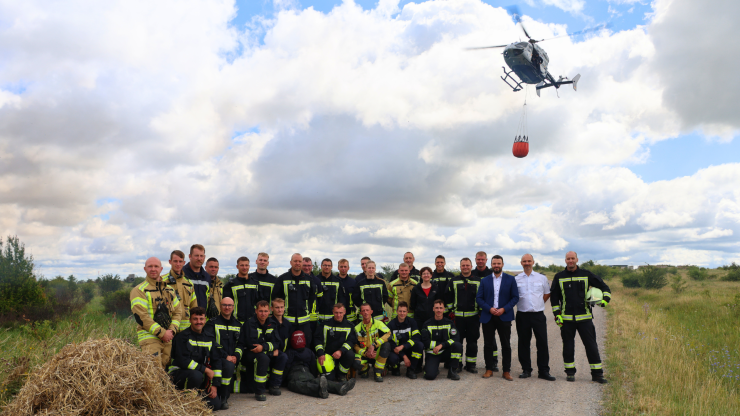
Feuerwehranwärter des aktuellen Grundlehrgangs mit dem Ausbildungsteam auf dem Truppenübungsplatz Ohrdruf. Mit dabei: Bürgermeister Benjamin Koppe (3. von rechts) und Fachdienstleiter Feuerwehr Nick Ludwig (2. von rechts).
© Stadt Jena