

Jena is getting smarter
The city of Jena is systematically driving forward its digital transformation with the Smart City project. The current 2025 status report, which will be presented to the city council, makes it clear that the measures are visibly being implemented, cooperation within the city association is close and reliable - and Jena is increasingly integrated into regional, state and national networks.
"We have created digital and analogue contact points in Jena that are increasingly connecting administration, municipal utilities, science, business and urban society - and thus creating very concrete added value in everyday life," explains Mayor and Head of Digitalization Benjamin Koppe. "Our goal remains: Digitalization should be tangible for everyone - understandable, low-threshold and with direct benefits for the people in our city."
ProbierLaden, JEDI and Digitalagent: different approaches, one common goal
With the ProbierLaden and JEDI - the Jena Digital Innovation Hub - two central locations have been established that reach different target groups and make digital topics accessible in their own way.
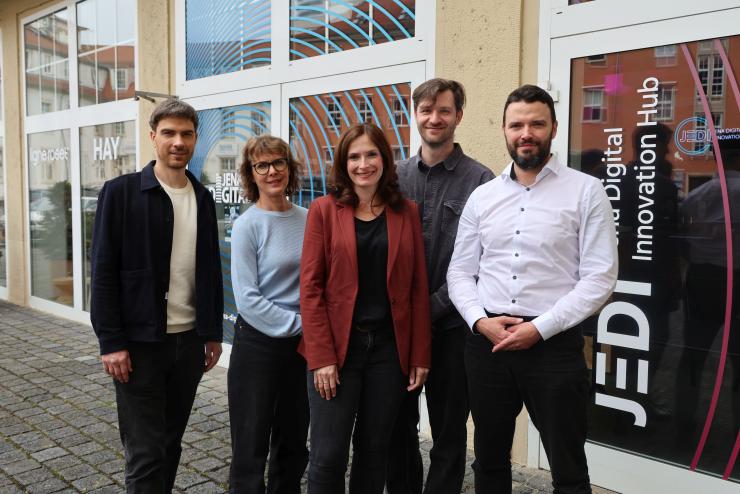
Berichteten über den aktuellen Stand im Smart City Projekt Jena (v.l.): Domenique Dölz, Teilprojektleiter, Heike Stötzner, Teilprojektleiterin, Gesamtprojektleiterin Dorothea Prell, Jan Wiescholek, Teilprojektleiter, sowie Bürgermeister Benjamin Koppe
© Stadt Jena
The ProbierLaden primarily addresses citizens directly: as a low-threshold place to try things out, learn and ask questions. The JEDI, on the other hand, is aimed more at the specialist public, business and science and creates space for exchange, innovation and concrete project development. Both formats show how digital urban development can have an impact both across the breadth of urban society and in the innovation ecosystem.
This spectrum is complemented by the digital agent, who has been supporting three Jena model schools on their path to digital transformation since fall 2024. The aim is to anchor digital tools in lessons in a meaningful way and to strengthen the skills of teachers and pupils in the long term.
Digital approaches were also tested further in the area of healthcare: the telemedicine room in the smart district of Jena-Lobeda provides practical experience for new forms of care. In collaboration with municipalities such as Langenwolschendorf and Crossen an der Elster, we are examining how such approaches can be further developed, particularly in rural areas.
The healthcare apartments in the Smart Neighborhood Jena-Lobeda are another example of successful consolidation. They were taken over by Jena University Hospital on January 1, 2026 and will continue to operate there independently in future. This means that a healthcare service developed in the Smart City project has been successfully transferred to existing structures in the long term.
Networking as a driver for development and transfer
A central focus of the project work is on networking and knowledge transfer. The Smart City team contributed its experience at events such as the Smart Cities Model Projects funding program, the Thuringian eGovernment Congress and the Smart Country Convention in Berlin. The exchange shows that many municipalities are facing similar challenges. Jena therefore deliberately sees its projects as transferable approaches. The aim is to develop solutions in such a way that they can also be used and further developed in other cities and regions.
Participation makes digitalization visible
Citizen participation remained a central component of the project in 2025. Low-threshold offers such as the tasting store, hands-on activities at the children's and family festival "Your day in paradise", the Smart City expert group format and hackathons reached different target groups and made digitalization a tangible experience.
The project also attracted a great deal of media attention: MDR and ZDF reported on the Smart Quarter Jena-Lobeda and the ProbierLaden as examples of innovative approaches in healthcare and digital education.
"The strong response shows that we are on the right track with our Smart City strategy," emphasizes Dorothea Prell, overall project manager and Smart City representative for the city of Jena. "It is crucial for us that the projects do not remain abstract, but become visible in everyday life - and that we consider at an early stage how successful approaches can have a lasting effect."
Looking ahead: continuity and long-term impact
The measures under the funding program will continue to be implemented until 2027. At the same time, the question of continuation will come more into focus. In view of the end of the project and the budget planning for 2027/2028, the city is examining at an early stage which structures and offers can be secured and continued in the long term.
This is not just about individual projects, but also about new ways of working: cross-departmental collaboration, participation, data expertise, open interfaces and cooperation within the city network. The aim is to further develop successful approaches so that they have a lasting effect.
"Jena remains on course for success in digital urban development," summarizes Benjamin Koppe. "With a stable project structure, strong partners in the city association, a clear strategic direction and a culture of participation, we are well positioned to take advantage of the opportunities of digitalization for all Jena residents."