

National Warning Day on September 10, 2026
On Thursday, September 10, 2026, the nationwide Warning Day will take place. The city of Jena is once again participating in this joint day of action organized by the federal government, the states, and local municipalities, which is coordinated by the Federal Office for Civil Protection and Disaster Assistance (BBK). The goal is to test the various warning systems and how they work together, identify potential weaknesses, and familiarize the public with the warning channels and signals.
Starting at 11:00 a.m., various warning devices will be activated in Jena. These include sirens and public address announcements, as well as warning apps, cell broadcast, and digital information systems throughout the city and on public transit. The all-clear will be given around 11:45 a.m.
“Modern warning systems are a central component of our municipal emergency response. It is crucial that, in the event of an emergency, as many people as possible are reached quickly and reliably through various channels—regardless of where they happen to be at the time. Warning Day gives us the opportunity to regularly test this coordination and, at the same time, raise awareness of what a warning means and how to stay informed in an emergency,” explains Mayor and Head of Public Safety Benjamin Koppe.
What exactly happens in Jena?
In Jena, Warning Day is coordinated by the Fire Department. At 11:00 a.m., the digital sirens in the city will be activated. The warning signal consists of six tones, each lasting five seconds, with a five-second pause between them. This is followed by a voice announcement stating: “Attention! Attention! This is the City of Jena. This is a test alarm.”
Currently, 25 digital sirens are in operation in the Jena city area. The siren network is being gradually expanded to further improve warning coverage throughout the city. In neighborhoods not yet covered by sirens, warnings are also issued via loudspeaker announcements.
At the same time, information is disseminated through additional warning channels, including warning apps and digital displays on public transportation and throughout the city. Information about the warning day is also available on the city’s website and through the City of Jena’s social media channels.
At 11:45 a.m., the all-clear will be sounded via the sirens with a continuous one-minute tone.
Cell Broadcast: Alerts Directly to Your Cell Phone
Cell broadcast has now become an integral part of the warning mix. Through this system, a warning message is transmitted directly to compatible cell phones in the respective area via the federal government’s modular warning system. The warning is triggered centrally on the nationwide Warning Day by the Federal Office for Civil Protection and Disaster Assistance (BBK). No special app or registration is required.
To receive a Cell Broadcast message, the cell phone must be turned on, connected to the cellular network, and technically capable of receiving the signal. If the device is in airplane mode, it cannot receive the alert.
Important: All-clear alerts are not currently sent via cell broadcast. The all-clear alert at 11:45 a.m. is issued via the other warning channels used previously.
Further information on cell broadcast and the requirements for reception is provided by the Federal Office for Civil Protection and Disaster Assistance (BBK): www.bbk.bund.de/Cell-Broadcast
Further information on warning systems and civil protection in Thuringia is available at: www.sicher-und-gewarnt.de
JenaZentral Answers Questions
During Warning Day, citizens can contact JenaZentral with any questions by calling 03641 49-0. Important: Warning Day is a test alert. There is no danger to the public.
Why is there a nationwide Warning Day?
The nationwide Warning Day is a joint initiative of the federal government, the states, and local municipalities. In addition to testing the technical capabilities of the warning systems, the goal is to raise public awareness about warnings and how to respond correctly in an emergency.
Warnings may be necessary, for example, in the event of major fires, flooding, hazardous material spills, or other significant emergency situations. The more familiar people are with the various warning channels and signals, the faster they can interpret a warning and obtain information about the specific danger and necessary safety instructions.
For more information on the nationwide Warning Day: www.bbk.bund.de/bundesweiter-warntag
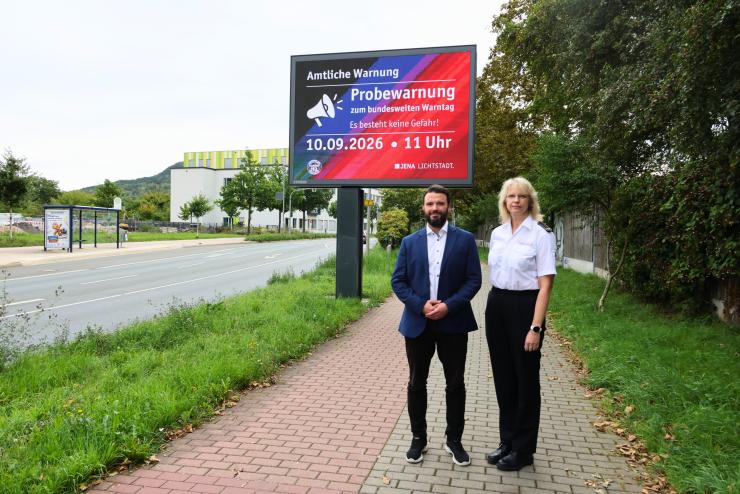
Warnung auf mehreren Wegen: Bürgermeister Benjamin Koppe und die stellvertretende Fachdienstleiterin Feuerwehr, Anja Le Maire, vor einer digitalen Anzeigetafel zum bundesweiten Warntag. Am 10. September testet Jena das Zusammenspiel seiner Warnsysteme.
© Stadt Jena