

A New Lease on Life for the Jena Romantic House
It was from here that the rebellious ideas of the early Romantics were once spread throughout the world, giving rise to one of the most influential movements in European cultural history: The Romantikerhaus in downtown Jena is the only museum in Germany that conveys the history and significance of early Romanticism at its original historic site. To convey the special role of this location and the building in a contemporary way, the Romantic House is undergoing a comprehensive redesign. The transformation is taking place in three phases: The outdoor areas are being redesigned while taking into account historic preservation requirements, and inside the building, structural modifications are planned and the permanent exhibition is being redesigned.
Classified as a culturally significant institution of national importance
This comprehensive redesign is possible because the museum has been included in the funding program “Investments in Nationally Significant Cultural Institutions in Germany” (INK). Through this program, the State Ministry of Culture and Media supports outstanding national cultural institutions; well-known examples include the Bavarian State Opera, the German Hygiene Museum in Dresden, and the Hamburger Kunsthalle. The redesign of the permanent exhibition, the foyer, and the space for temporary exhibitions is being supported through the INK program with approximately 560,000 euros from the federal government and just under 170,000 euros from the state of Thuringia, with total eligible costs amounting to 1,119,700 euros.
“I am very pleased that the Romantikerhaus in Jena can be comprehensively redesigned with federal funding, thereby strengthening an important cultural beacon in eastern Germany. It is a special place that brings early Romanticism to life right where it made history,”
says Elisabeth Kaiser, Minister of State and Federal Government Commissioner for Eastern Germany.
“Early Romanticism in Jena had an impact far beyond Thuringia and has lost none of its fascination to this day,”
emphasizes Prof. Dr. Steffen Teichert, State Secretary for Science and Culture at the Thuringian Ministry of Education, Science, and Culture.
“I am all the more pleased that, together, we can open up new horizons for the Romantikerhaus. I would like to extend my special thanks to the federal government for its vital support of this project. Together with the city of Jena, we are laying the groundwork to make this special place come alive, bring it into the present, and allow a broad audience to experience it anew.”
“Jena, as the birthplace of German Romanticism, has garnered increasing attention in public perception both nationally and internationally in recent years. The recognition of our Romantikerhaus as a culturally significant institution of national importance reflects this development and is, at the same time, an important signal from the federal government,”
says Johannes Schleußner, Head of the Cultural Affairs Department. In addition to serving as a museum with a permanent exhibition and up to three temporary exhibitions per year, the Romantikerhaus sees itself as a place of encounter, thus building on the early Romantic ideal of “Romantic conviviality.” After the renovation, the house will offer space for readings, concerts, lectures, and gatherings.
“I would like to thank everyone who worked to support this project,”
the department head says gratefully.
New exhibition to be sensory, participatory, and inclusive
In 1981, following extensive renovation, the house was opened as a memorial to Jena’s early Romantic movement and as an exhibition space for the art collection. It has existed as an independent literary museum with its current permanent exhibition since 1999. After more than 25 years, the history and significance of Early Romanticism are now to be conveyed to a broad audience in a contemporary format. This process is being overseen by the municipal agency JenaKultur, under which the Romantikerhaus operates as part of the Jena Municipal Museums.
“Jena has an exciting history stretching back at least 1,000 years. And within that history, there is a truly unique feature that, even in the national context, has remained far too much under the radar: Jena’s Early Romanticism,”
emphasizes Friedrun Vollmer, director of JenaKultur.
“I am very pleased that this fact is now being acknowledged through the redesign of the permanent exhibition and the accompanying comprehensive renovation of the area surrounding the so-called Romantikerhaus, which is, in fact, the former residence of the philosopher Johann Gottlieb Fichte. With the generous financial support from the federal and state governments—for which we are grateful—we will be able to introduce future generations to the Jena Early Romanticism movement as a ‘revolution of the mind,’ with all its profound effects on modern literature, philosophy, science, and the Western understanding of freedom and art.”
The presentation will utilize new digital and analog educational tools and aims to be sensory, participatory, and inclusive. The specific design of the future permanent exhibition will be developed in collaboration with an exhibition and media design firm, based on a new conceptual framework. The bidding process is currently underway. Starting October 5, 2026, the Romantikerhaus will initially close to the public. Renovation work will begin in 2027, and the museum is scheduled to reopen sometime in 2029.
The goals are accessibility, visibility, and a more pleasant visitor experience
Before the new permanent exhibition can be installed, the outdoor facilities must be completed and structural adjustments made to the interior. These extensive renovation and restoration works are being carried out by the municipal real estate agency Kommunale Immobilien Jena (KIJ). The goal is to make the ground floor accessible to people with disabilities and to create a combined event and exhibition space there, as well as to redesign the foyer and ticket office area. On the second floor, two new rooms for temporary exhibitions are also to be created.
A fundamental renovation is also planned for the open space surrounding the building. A key priority is to make the area more accessible. In consultation with the City of Jena’s Advisory Board for People with Disabilities, solutions were agreed upon to ensure the museum is accessible in the future. With seating areas, landscaping, and lighting, the courtyard will be designed to invite visitors to linger and will be upgraded as an event space. The two museum entrances on Löbdergraben and Unterm Markt will be made more visible through a unified wayfinding system. Information kiosks and strategic lighting are intended to make the building—which is set back from the street—more noticeable. Historically protected elements, such as the bronze busts of Caroline, August Wilhelm, and Friedrich Schlegel, the pergola, and the fountain, will be carefully integrated into the redesign. The cost of the construction work inside the building, carried out by KIJ, amounts to approximately 300,000 euros. Approximately 600,000 euros are being invested in the redesign of the outdoor areas, of which about 400,000 euros are covered by federal and state urban development grants.
“By improving accessibility through the renovation of the interior spaces and outdoor areas, we want to make cultural participation possible for even more people,”
says KIJ Director Beate Wachenbrunner.
“At the same time, the redesign of the outdoor areas creates an attractive place for everyone to gather, linger, and meet—and thus enhances the quality of life right in the heart of downtown Jena.”
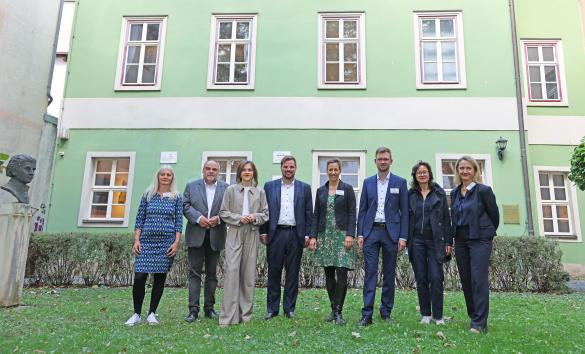
Gemeinsame Vorfreude auf den Start der anstehenden Umgestaltung des Jenaer Romantikerhauses.
© Stadt Jena