

2023 monitoring report on climate protection published
Background
The city council resolution "Jena climate-neutral by 2035" of 14.07.2021 set an ambitious climate protection target. The path to climate neutrality is outlined in the subsequently developed Climate Action Plan (KAP), which was adopted in 2023 with a comprehensive catalog of measures. The climate neutrality pathway developed for the city of Jena is based on the determined urban energy consumption in the industrial, commercial/trade/services (CTS), private households and mobility sectors and the greenhouse gas emissions derived from this in 2019.
The recently published monitoring report on climate protection (energy consumption data and greenhouse gas balance of the city of Jena) was compiled by the Thuringian Institute for Sustainability and Climate Protection (ThINK) on behalf of the city of Jena. It summarizes the results on the development of energy consumption and greenhouse gas emissions for the year 2023. The monitoring report provides a differentiated evaluation by sector and by energy source, such as fuels, electricity, natural gas and district heating.
The full report is available on the City of Jena's environmental portal.
Positive development in energy consumption
Compared to 2019 - the base year of the Climate Action Plan - energy consumption continued to fall in all sectors and was below the Climate Action Plan target in 2023 overall.
Specifically, the energy reduction targets were exceeded in the industry and trade/commerce/services sectors, while they were missed in the private households and mobility sectors.
Total energy consumption and consumption in the individual sectors for the last 10 years are shown in Figure 1.
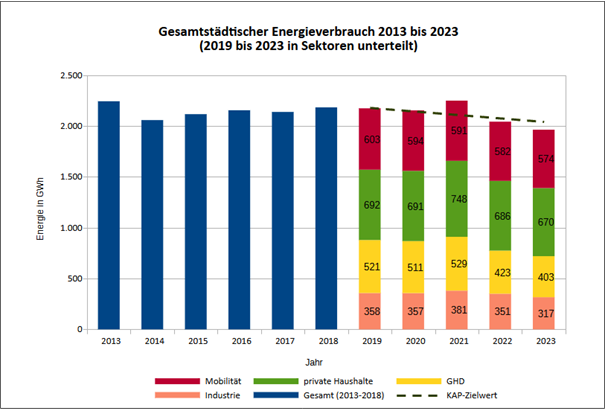
Abbildung 1: Entwicklung des gesamtstädtischen Energieverbrauchs (2013 bis 2023) und Aufteilung des Energieverbrauchs in Sektoren (2019 bis 2023)
© ThINK – Thüringer Institut für Nachhaltigkeit und Klimaschutz GmbH
Greenhouse gas emissions fall, but fall short of the target value
Greenhouse gas (GHG) emissions are calculated on the basis of the energy balance using specific emission factors.
Although GHG emissions for the city as a whole fell in 2023 compared to 2019, the target value of the Climate Action Plan was clearly missed. With the exception of the trade/commerce/services sector, GHG emissions in all sectors are above the target values of the Climate Action Plan.
The reduction in GHG emissions targeted by 2035 is based on two effects:
-
a gradual reduction in energy consumption and
-
a shift in the composition of energy sources towards more renewable energies.
Energy consumption in Jena has been further reduced, but the replacement of fossil fuels with renewable energies has not progressed as quickly as intended, meaning that the ambitious target path from the Climate Action Plan could not be achieved in 2023.
The total greenhouse gas emissions and the emissions in the individual sectors for the last 5 years are shown in Figure 2.
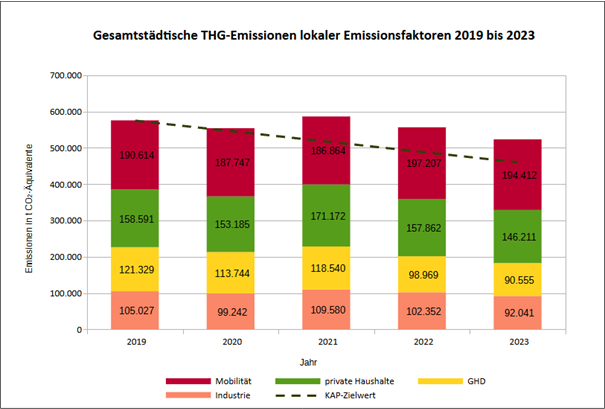
Abbildung 2: Entwicklung der THG-Emissionen und Aufteilung der Emissionen in Sektoren (2019 bis 2023)
© ThINK – Thüringer Institut für Nachhaltigkeit und Klimaschutz GmbH
Switch to renewable energies is slowly gaining momentum
The expansion of renewable energies in Jena made significant progress in 2023. Photovoltaics accounts for by far the largest share of installed capacity and also recorded the largest increase in 2023.
However, in 2023, only around 7% of the city's total consumption was covered by electricity generated from renewable energy sources. In the heating sector, 2 % of the city's total consumption was generated from renewable energies.
The increase in the installed electrical output of renewable energies and the shares of the individual energy sources for the last 10 years are shown in Figure 3.
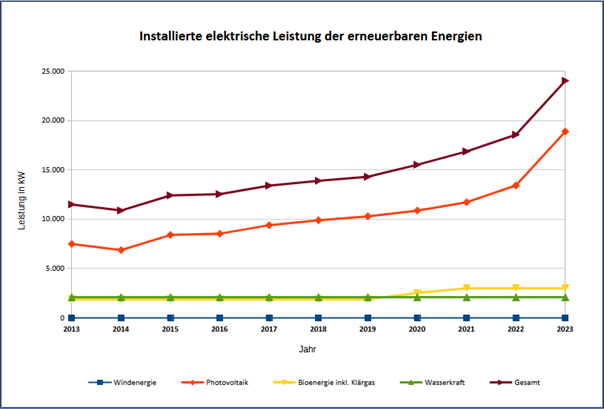
Entwicklung der insgesamt installierten Anlagen zur Nutzung erneuerbarer Energien nach installierter Leistung in der Stadt Jena seit 2013
© ThINK – Thüringer Institut für Nachhaltigkeit und Klimaschutz GmbH
Kathleen Lützkendorf, Head of the Department for Social Affairs, Health, Immigration and Climate, draws the following conclusion from the study: "The greatest potential for reducing greenhouse gases in Jena lies in the conversion of energy sources to renewable energies. In terms of electricity generation, the positive development in the expansion of photovoltaics should be continued. And with the municipal heating plan, the strategic planning for a climate-neutral heating supply was adopted by the city council in June 2025, which is to be gradually implemented in the coming years."