

Commemoration of the victims of National Socialist tyranny
Speech by the Lord Mayor to commemorate the victims of National Socialist tyranny
Ladies and Gentlemen,
Since 1996, January 27, the day in 1945 when the Red Army liberated the Auschwitz-Birkenau extermination camp, has been observed in Germany as the "Day of Remembrance of the Victims of National Socialism". The day is dedicated to the memory of the victims of the Nazi regime: Jews, Christians, Sinti and Roma, people with disabilities, homosexuals, political dissidents as well as men and women of the resistance, scientists, artists, journalists, prisoners of war and deserters, forced laborers.
It is a day of remembrance to commemorate and honor the millions of people who were disenfranchised, persecuted, tortured and murdered under National Socialist tyranny. At the end of 2005, the United Nations General Assembly declared January 27 the "International Day of Commemoration in Memory of the Victims of the Holocaust". It has been observed worldwide since 2006.
More than 80 years have passed since the end of the Second World War and the collapse of the National Socialist regime in Germany. At that time, the cruellest war of all time - in terms of the number of victims and the countries and regions of the world involved - came to an end, along with a machinery of extermination against people that was unimaginable up to that point and remains so to this day. On the way to this end was the liberation of the Auschwitz-Birkenau concentration and extermination camp, the camp that has come to epitomize the Holocaust, 81 years ago today.
But the suffering of the victims of the Nazi dictatorship, especially the Jews, did not end abruptly with the day of liberation. The crimes of the past 12 years were so profound and comprehensive that it was not possible to return to the time before. The survivors were scarred for life, with or without a tattooed number on their arms. The trauma they experienced lives on in the families of their descendants to this day.
After the Shoah, Jews lived in a German society in which their presence was perceived as a provocation. The majority of Germans rejected any reparations and reckoned with their own suffering.
Only a few German Jews, out of more than half a million people, lived to see the end of the war under German rule in 1945. Around a third of them were murdered and more than half were expelled abroad. Only around 15,000 people survived the years of persecution without being deported - often in "mixed marriages" or in hiding; a further 9,000 people survived as concentration camp prisoners. A significant number of the concentration camp prisoners were liberated outside the camp grounds: many were stranded on death marches in small towns in the middle of Germany, while others were able to escape in the final weeks of the war.
The Allies set up immediate care for the sick and emaciated, but thousands more died in the first few months after liberation. Theresienstadt was initially placed under typhus quarantine before the repatriation of the people to their countries of origin could begin at the end of May, with Red Cross buses to occupied Germany. The Allied authorities also provided for the return of survivors from Germany.
Probably most of the few Jewish concentration camp survivors from Germany returned to their places of origin in 1945, driven by the hope of finding other survivors. The old home seemed the most likely post-war meeting place. And what was the alternative?
Many wanted to emigrate, but that was not possible. The USA had restrictive immigration laws based on country quotas and Great Britain limited immigration to Palestine. The Western Allies set up large collection camps for "displaced persons" (DPs) to care for and administer the millions liberated from Nazi captivity.
It is estimated that there were around 12 million DPs in Europe, around 11 million of them in the western occupation zones: former forced laborers, prisoners of war, concentration camp survivors and victims of Nazi persecution who were unable or unwilling to return home after their liberation.
Jewish and non-Jewish DPs were initially housed together in the camps. Among them were former Nazi collaborators, some of whom were hostile to the Jewish survivors. The supply situation gradually improved:
In the US zone, special camps were set up in 1945 just for Jewish DPs, but initially, catastrophic conditions prevailed in the accommodation everywhere. The decision to return to their place of origin was therefore also made by German-Jewish survivors out of necessity - in the hope of having a better life there than in the collection camp.
Whether in DP camps or in urban ruins - liberated Jews all over Germany began to organize themselves quickly after the end of the war. However, it is misleading to assume a heterogeneous community here.
Jewish soldiers from the Allied forces provided great support for the liberated people. The survivors searched for their relatives with great urgency and advertised in the press. New Jewish communities published notices about new arrivals. Being together with other survivors provided the central shelter and support.
While communities with German-Jewish boards were soon founded in northern Germany, in the British zone, Jewish organization in the US zone was mainly driven by Eastern European DPs. By the summer of 1945, there were already more than twice as many non-German Jews in Germany as German Jews. In the following years, their number grew to around 250,000 with the influx of refugees from Eastern Europe - mostly Jewish Poles repatriated from the Soviet Union fleeing renewed pogroms. Due to the better supply conditions, the vast majority moved to the US zone.
A wide range of cultural life developed in the Eastern European Jewish DP communities, in camps or in shared flats in German cities: The press, theater groups and historical commissions were founded in self-administration. There was soon a huge marriage and baby boom among the mostly young adults - unlike in the German-Jewish community.
Around half of the German survivors had survived in marriages with non-Jewish partners, some at an advanced age in Theresienstadt. Apart from having survived the Nazi era as Jews, the groups were separated by many things: age, experiences between Auschwitz and the southern Soviet Union, language, socialization and religious practice.
The central question was the future of Jewish life in Germany. While the communities led by German Jews soon tended to install long-term structures, the so-called committees of Eastern European DPs regarded themselves as liquidation communities. They were only supposed to exist until they were able to leave the "land of the murderers" for Palestine.
The status of those who had been persecuted as Jews or "half-breeds" under the Nuremberg Laws but were not Jewish under Jewish law, which was based on their mother's status, was also disputed. Survivors from "mixed marriages" were viewed with reservations.
It was assumed that they were close to the perpetrator society and the persecution was considered less serious. They were regarded as second-class victims and were given lower priority in terms of aid.
Jews in post-war Germany lived against heavy resistance. According to opinion polls from 1946, around a third of the West German population were staunch anti-Semites. Only 15 percent were in favor of rebuilding Jewish life in Germany. After the Shoah, the old mistrust was combined with new defenses of guilt. Jews were now hated because their presence was a reminder of German crimes.
After the German defeat in the war and a few months of shock, anti-Semitism was soon on display again - in the form of verbal attacks and damage to property.
The US military government demanded rigorous prosecution and the Jewish remnant community soon received international attention.
US military governor John McCloy described their situation as one of the real "touchstones of Germany's progress". German authorities also harshly rejected attacks, anti-Semitism became taboo and took on latent forms. Eastern European DPs were particularly affected - anti-Semitism against them was framed as xenophobia.
From 1945 onwards, the Allies decided on an immense upheaval of German law. Laws initiated by the US military government provided for former victims of persecution to be given back their lost property and for German society to be de-Nazified. Some Nazi persecutees took up positions in the judiciary and administration.
In contrast, the majority of the German population came together as a defensive and "victim" community, rejecting restitution and counting against their own suffering.
Most of the German-Jewish survivors came from the city and settled there again. Others, mostly returnees from concentration camps, made their way back to the countryside. Their neighbors had benefited from or participated in their persecution. Many had welcomed the expulsion, marginalized Jews, stood idly by and watched the deportations and enriched themselves by auctioning off household goods and furniture.
After their unexpected return, only a few Germans were prepared to help. They were often the same people who had already helped in the 1930s, or those who suddenly presented themselves as benefactors for fear of Allied prosecution.
In the area of emergency aid, a patchwork of different measures initially emerged in West Germany, depending on the Allied zone, who was responsible in the authorities and the material situation on the ground. While the care of non-German DPs was taken over by UNRRA (United Nations Relief and Rehabilitation Administration) and private aid organizations, the German authorities were already responsible for the care of German victims of persecution in 1945.
The military governments instructed them to give priority to persecuted persons in terms of housing, food and job placement. Survivors from "mixed marriages" were regularly given lower priority if they had not been imprisoned.
In cities such as Frankfurt am Main or Hamburg, persecuted persons were accommodated in confiscated apartments belonging to National Socialists. Elsewhere, survivors were assigned to individual rooms in their former homes. From then on, the former owners had to share their old home with those to whom they had been forced to sell their house and land.
In rural areas, where there was no anonymity, disputes over property characterized the early days in the neighbourhood. These were also fought out violently.
Provisional compensation laws were introduced in the US zone as early as 1946. From then on, compensation was paid out of a special budget from denazification funds. Anyone who had been in a concentration camp could apply for money as an advance on later compensation. One year after the Shoah, survivors in need were no longer provided for at the expense of the welfare state, but at the expense of the survivors themselves, as a deduction from their later claims.
Most of them - despite illness and chronic suffering - quickly returned to work. However, only a few had professional success; most Shoah survivors in West Germany lived in poverty in the long term.
Another area in which German Jews negotiated with people around them in the post-war period was denazification. Some had the courage to testify in court against National Socialist perpetrators. As former victims of persecution, they were credited with having a major influence on the trials.
National Socialists sought their favor or offered them money to persuade them to give exculpatory testimony. In the countryside, where survivors tried to gain a foothold among non-Jews alone, deals were negotiated: Exculpatory testimonies in exchange for the restitution of property. However, the influential role of the persecuted did not last. By 1948 at the latest, their testimony was no longer needed.
As the East-West conflict intensified, the political course for West Germany was set anew and the USA decided in favor of Western integration.
With the founding of its state in 1949, the FRG declared denazification to be over. As the US military presence dwindled, anti-Semitic attacks increased again. In the course of the founding of the state and the restructuring of the authorities, a number of Jewish civil servants had to resign from their positions in state compensation authorities, and their expulsion was accompanied by anti-Semitic smear campaigns.
After the founding of Israel and relaxed entry regulations to the USA in 1948, most of the survivors emigrated - but not all of them. Before 1948, the presence of Jews in the "land of murderers" was difficult to bear for Jewish interest groups around the world, but it was tolerable as an interim solution. It was also a means of exerting political pressure for the establishment of Israel.
However, the establishment of permanent Jewish communities in Germany and the decision of Jews to stay or even emigrate there was rejected abroad.
This development was despised within the Jewish community as a contradiction to the self-image as a collective that had been strengthened after the Shoah and as a defilement of Israel's dignity. The small remaining Jewish community in Germany lost the support of international Jewish organizations. In fact, only around 2,500 Jews had returned to Germany from their countries of exile by 1952.
In 1950, the Jewish population in Germany was only around 30,000 people. Among them, German Jews and Eastern European DPs now roughly balanced each other out. The communities shrank, DP representatives merged with German-Jewish-led communities - not without tensions.
Marriages with non-Jewish partners remained highly controversial and were rejected by the new Central Council in its efforts to preserve Judaism.
Finding prayer leaders and religious teachers was a particular hurdle, as hardly any rabbis decided to work in Germany. Many communities were too small and too poor to offer weekly services or kosher food. The Secretary General of the Central Council, Hendrik van Dam, soon declared that the idea that Jews had no place in Germany was outdated. The community that was still present wanted to stay, but retreated into the private sphere.
For the young FRG, the fact that a Jewish population remained in the country was a great gift, as it proved to the world that West Germany was making a new democratic start.
After the end of the denazification and restitution procedures at the end of the 1940s, there was no longer any need for the majority population to deal with their Jewish neighbors. Their presence became less explosive for them and gradually less important.
Survivors in West Germany became increasingly invisible. In cities such as Frankfurt am Main, where Jewish communities continued to exist, they provided a social safe haven. At the same time, the urban space offered the opportunity to choose one's personal environment and maintain distance.
This was not possible in the countryside. If men became involved in community life, enjoyed professional success and started new families, they had the chance to regain a foothold here. Widowed women, on the other hand, lived permanently on the fringes of village society.
There are other aspects of Jewish life after the end of the war that are worth mentioning with regard to the Soviet occupation zone and the GDR, which could be the subject of a future speech.
In view of the continuing hostility and poverty, it is hard to believe that Jews decided to stay in Germany. Under the pressure of not actually being allowed to live there, and because the country offered neither a full sense of identity nor security, many lived for decades "with packed suitcases" and the feeling that they were not really allowed to feel at home.
Ladies and gentlemen,
81 years after Auschwitz, anti-Semitism is once again so widespread and so obvious in Germany that Jews feel unsafe or even afraid to openly profess their faith and show it in everyday life. Even if we are not at the point where Jews were in Germany after the Second World War, what we have heard must be a warning to us that verbal anti-Semitism can always turn into psychological and physical violence and that this has happened again and again in recent months and years.
We must therefore take a clear stand against all forms of anti-Semitism and other group-related misanthropy.
The current global political situation and the changes in the past year in particular illustrate how quickly systems of order and values can change and become fragile, even in our Western world. Together, let us hold on to the fact that human dignity is inviolable, the dignity of every human being.
We must remain committed to ensuring that the events and crimes of National Socialism and the Second World War are not forgotten. We still need to make an effort and be aware and clear that we stand up for human rights and human dignity in our daily actions. They are the basis for the peaceful coexistence of mankind, for our coexistence. Let us act together here!
Gedenken an die Opfer nationalsozialistischer Gewaltherrschaft
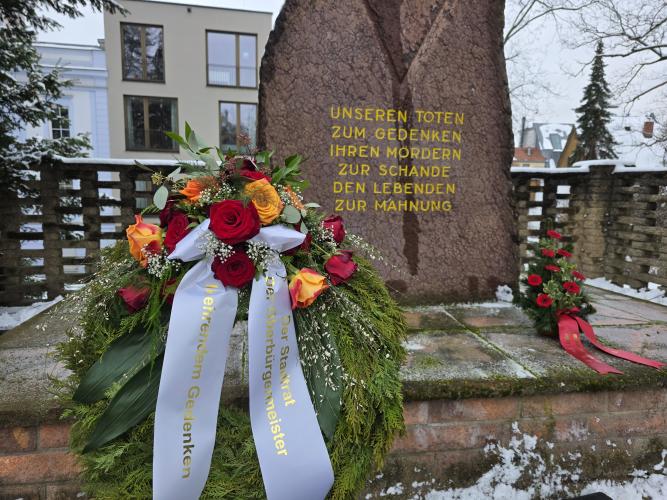
Gedenken an die Opfer nationalsozialistischer Gewaltherrschaft
© Stadt Jena
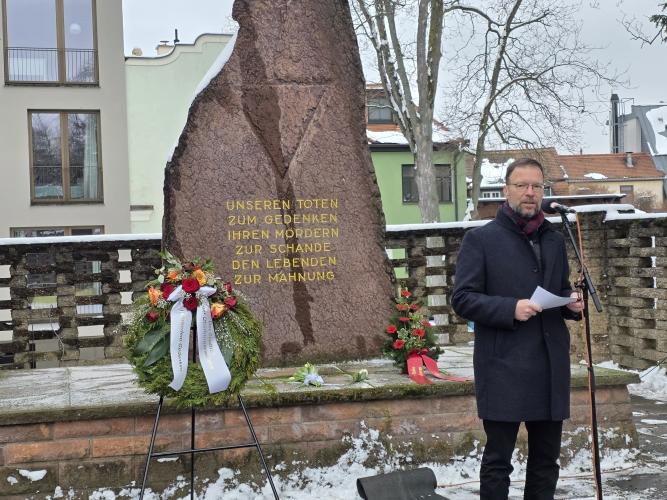
Gedenken an die Opfer nationalsozialistischer Gewaltherrschaft
© Stadt Jena
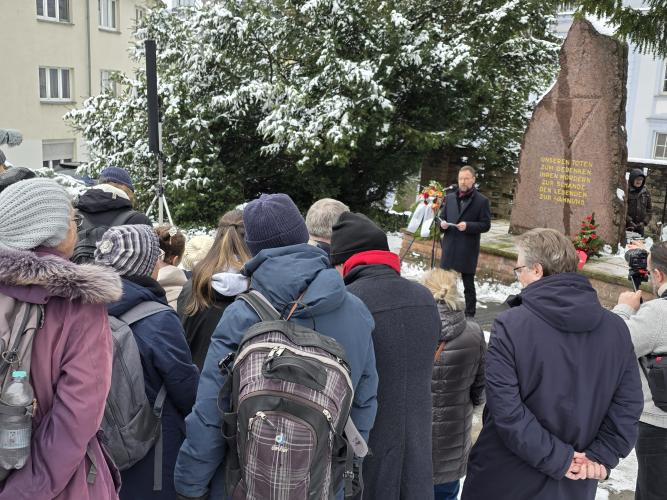
Gedenken an die Opfer nationalsozialistischer Gewaltherrschaft
© Stadt Jena
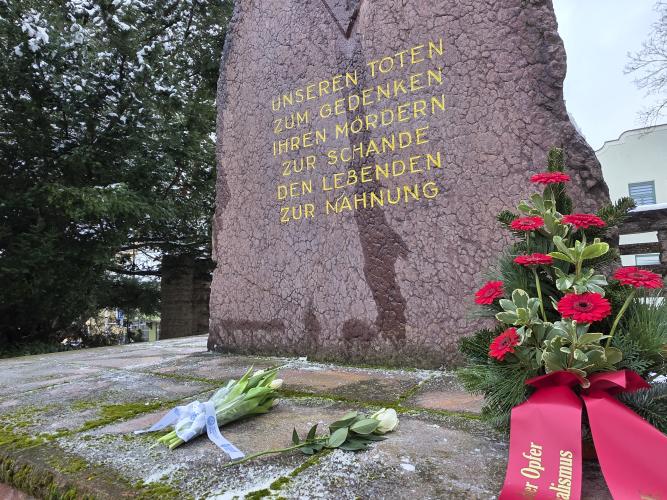
Gedenken an die Opfer nationalsozialistischer Gewaltherrschaft
© Stadt Jena


