

Commemoration of the bombing of Jena 81 years ago
The speech by Lord Mayor Dr. Thomas Nitzsche
Ladies and Gentlemen,
Dear Mr. Simon,
I am very pleased that we are organizing this commemoration together with you today as pastor of the Stadtkirche. The reason is that the church is unfortunately currently closed due to the renovation of the ceiling. However, in recent years since the City Church was accepted into the Coventry Community of the Cross of Nails, we have been working more closely together on the commemoration. Perhaps a small tradition will grow out of this; I would be very pleased.
Ladies and gentlemen,
A warm welcome to you all!
As we do every year, on March 19 we look back on the heaviest bombing raid on Jena in 1945 at the end of the Second World War, 81 years ago today.
The first bombing raid on Jena took place as early as May 1943 and claimed 12 lives. Royal Air Force high-speed bombers attacked the Zeiss and Schottwerke factories at low altitude. The attackers did not come by chance. They knew that Carl Zeiss Jena was a major producer of military optical equipment and therefore an important target for the war effort.
In the spring of 1945, the bomber planes usually attacked Jena as a secondary target. They were already on their return flight and had previously dropped most of their bomb load over the central German and Silesian hydrogenation plants.
The heaviest bombing raid occurred on March 19, 1945. It was reported that the sirens sounded for the third time at 12.20 p.m. that day, sounding the air raid warning. At 1.16 pm, 197 aircraft of the 3rd Air Division of the 8th US Army Air Force reached the Jena area.
In seven waves, they again attacked the main Carl Zeiss factory on the edge of the old town. However, only six to eight bombs hit this target, six hit the nearby Jena glassworks Schott & Genossen. The bulk of the explosive, phosphorus and incendiary bombs fell on the area between Fürstengraben and Holzmarkt, about 250 meters away.
Several hundred square meters of densely built-up residential and commercial areas were reduced to rubble within 20 minutes. Seven major fires broke out in the city center, which also spread to the tower, roof and hall of St. Michael's Church in the course of the afternoon. 220 houses, mainly in the city center, were completely destroyed. 236 people died, 100 were seriously injured and 150 others were slightly injured.
In March 2005, Annelies Rehberg, born in 1920, reported in the OTZ newspaper how she experienced the bombing of Jena and the last days of the war in 1945. Annelies Rehberg was the daughter of a fireman and the family lived in the fire station depot in Saalbahnhofstraße. Her father had to close down his cab business at the beginning of the war and was taken on by the security and disaster service, the SHD, which was founded by the volunteer fire department. The SHD had four fire brigades covering the whole of Jena, and Annelies Rehberg's father was responsible for one of them. (Side note: a professional fire department was not established until 1947).
In the event of an air raid, the vehicles had to leave the depot and were stored at various locations in the city. Two of them at Am Anger under the railroad underpass. During the air raid on March 17, 1945, this railroad underpass was bombed, the vehicles destroyed and the crews lost their lives. This left the town with only two fire engines.
On March 19, Annelies Rehberg was on her way to work at the post office when the sirens sounded near the library. She returned home. After the carpet of bombs had been laid by the planes, the dropping of incendiary and liquid bombs had begun.
Jena was now burning from the market, from Johannisstraße to Holzmarkt. Her father was deployed with his fire engine in Weigelstrasse and Johannisstrasse. The two vehicles were unable to save the old town. There was also a lack of hoses to extinguish the fire at the town church.
In the morning of the next day, her father came home completely exhausted and stunned. Blackened by smoke, his hands singed - and mute. He was no longer able to speak until later.
After March 19, it was decided that the fire engines would be stationed outside Jena. Gustav Rehberg's fire engine was parked in Tröbnitz near Stadtroda. On April 12, 1945, at the age of 63, he was shot dead by US soldiers after a mission in Stadtroda, possibly due to a misunderstanding. His coffin was placed in the cemetery building of the North Cemetery, where the many dead from the last bombing raid on the Saalbahnhof three days earlier also lay.
Annelies Rehberg could never forget how she had to walk past "the unbearably long line of dead people". There were no more coffins in Jena. Her father's was the last in this line of dead.
Annelies Rehberg had already lost a sister in the bombing raid on February 9, 1945. It was only three days after the bombing that her father, she and another sister found the buried sister under the rubble. Other relatives died in the bombing of Dresden and during the flight from East Prussia.
During the last bombing raid on Jena on April 9, 1945, three days before the Americans marched into Jena, the US Air Force destroyed the Saalbahnhof freight depot in order to paralyze rail traffic. The bombs cut a wide swath of devastation between Spitzweidenweg and Löbstedter Straße.
Among the victims of this attack were forced laborers from the Reichsbahnausbesserungswerk. Like the German residents, they had sought shelter in a pedestrian tunnel, which was destroyed by a bomb hit. Over 100 people died - the dead that Annelies Rehberg had to walk past.
Between 1940 and 1945, the "air raid siren" sounded 330 times in Jena. In total, more than 800 people died in bombing raids. 1,166 people were injured.
The dead and injured accounted for around 3 percent of the 79,000 inhabitants and refugees living in Jena at the time. As a result of the bombing, 17 percent of the houses and apartments in the city were so badly damaged that they were uninhabitable. A total of 2,763 residential buildings with 9,720 apartments were damaged.
Ladies and Gentlemen,
Annelies Rehberg's memories and the sometimes unbelievable numbers of victims and destruction illustrate what we always recall on this day of remembrance.
The report says a great deal about the power of destruction caused by wartime bombs, the powerlessness of civilians at the mercy of such an attack and the personal, individual suffering of the people affected, which came upon them in those hours of the attack and will accompany them for the rest of their lives.
For years now, news of bomb attacks and armed conflicts have unfortunately been part of our everyday news. According to statistics, there were more armed conflicts worldwide in 2025 than at any time since the end of the Second World War.
Again and again we see the terrible images of Russia's war of aggression against Ukraine, which has been going on for more than four years. The war is bitter everyday life in the country. On the front line, but also in the hinterland, where Russia repeatedly attacks with drones and bombs, destroys infrastructure and homes and puts people under permanent threat.
We have not forgotten the murderous Hamas attack on Israel in 2023 and the subsequent destruction of the Gaza Strip. The current images of the attacks on Iran, the Gulf states, Israel and Lebanon are shocking.
Even if the aim is often to primarily attack military targets, the civilian population is also repeatedly affected. People die, are injured or traumatized, lose their possessions and have to flee from the fighting. There is no such thing as a "clean" war. War is always destructive and associated with the death and suffering of people.
War, with all its consequences, has returned to our present and to our neighborhood. War is not a historical event from the past century, but a cruel present-day reality in many parts of the world and in the heart of Europe.
The escalation of the conflict in Ukraine and the shifts in power and roles in the transatlantic defense alliance make it clear that peace is by no means a given or even a foregone conclusion, but that it is endangered and must be protected and defended. Germany and Europe must be aware of their responsibility for this and politicians must act accordingly.
The war of aggression against Ukraine remains the current reason for this. Written memories of the bombing of Jena, such as those of Annelies Rehberg, make us aware of what war also meant for our city 81 years ago.
We all know that the bombing of Jena was a consequence of Germany's wars of aggression against its European neighbors, which triggered the Second World War.
Today we commemorate the victims of the bombing of Jena in the awareness that the war that started in Germany returned here with all its brutality.
Let us be grateful that we can live here today in peace. Let us show solidarity with the people who have to flee from war and need help. In the end, those who suffer are always people, like the victims of Jena and their relatives in 1945, like Annelies Rehberg, who we heard about today.
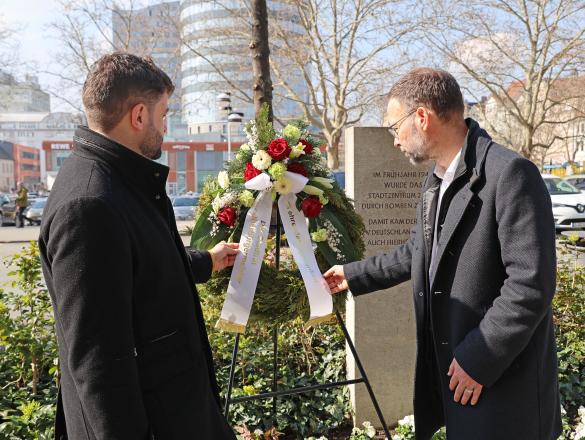
Pfarrer Andreas Simon und Oberbürgermeister Dr. Thomas Nitzsche erinnern an die Bombardierung Jenas.
© Stadt Jena