

Commemoration of the liberation from National Socialist tyranny
To commemorate the end of the Second World War and the liberation from National Socialist tyranny today, Lord Mayor Dr. Thomas Nitzsche gave a speech (the spoken word prevails). City historian Dr. Jenny Price also made a speech.
-------
"Ladies and gentlemen,
Welcome to our commemorative event to mark the day of liberation from National Socialist tyranny and the end of the Second World War in Europe. It was 81 years ago today that this special event finally brought peace to Germany and Europe and the final end of the National Socialist regime.
This day had been hoped for and longed for by millions of persecuted people; many Germans - perpetrators of the Nazi regime, soldiers of the Wehrmacht, loyal or passive citizens - had also feared this day, because they were afraid of what the future would bring, afraid of the retribution of the Allies.
Today, a good eighty years later, we live in a world in which memories of the unimaginable horrors of this war are gradually beginning to fade. There are hardly any contemporary witnesses left among us to remind us that what happened back then must not happen again.
Instead, in everyday politics, we struggle with the trivialization of National Socialist crimes and a resurgence of anti-Semitism on a scale that most of us here could never have imagined.
In addition, the Russian war of aggression against Ukraine has now been raging for four and a half years. The security architecture of the Western world that has existed for decades has begun to totter. Insecurity is spreading and is being exacerbated by the pressure on our society to change and adapt as a result of climate change and economic stagnation.
The relative security of past decades - and even these were not free of conflicts and armed confrontations - seems to be over. War is once again a means of political conflict in Europe. Armaments spending in Germany and around the world is rising to unprecedented heights. The conflicts and wars in the Middle East make it difficult to have confidence in lasting peace and solutions in the interests of the people.
But instead of seeking a solution through international cooperation, for which peace is always the first prerequisite, numerous politicians, parties and countries currently seem to be pinning their hopes on nationalism and isolationism - exactly the opposite of the lessons learned from the terrible armed conflicts of the first half of the 20th century.
May 8, 1945 was the day of Germany's surrender, the end of the war and the National Socialist dictatorship in Germany. The guns fell silent for good on the European theater of war. Jena had already been liberated four weeks earlier, when on April 12 and 13, 1945, US troops came from the west along Johannisstrasse and occupied the city from the east.
In the six years of war, an estimated, unimaginable 55 million people had lost their lives. Cities and rural areas were destroyed to an equally unimaginable extent.
Everyone has images of Berlin or Dresden, Warsaw or Kaliningrad, Coventry or Manchester, Volgograd or Leningrad in their minds.
The Soviet Union had by far the most victims with around 24 million people, almost 10 million soldiers and around 14 million civilians. These are almost unimaginable numbers, far more people than live in the new federal states and Berlin.
Ukraine, as part of the Soviet Union, paid by far the greatest blood toll: at least eight million war victims, including over five million civilians, women and children, who were murdered by the SS or the Wehrmacht in the German war of extermination.
These incredible figures include 1.6 million Jews who were killed by the Nazis in the Holocaust on the territory of Ukraine by firing squads.
The war also took place in Jena. Shortly before the war began on September 1, 1939, almost 2,200 Jena citizens were members of the Wehrmacht and the Reich Labor Service. The first obituaries for fallen soldiers soon appeared in the newspapers, some carried by the grief of loss, others by National Socialist phrases.
The number of war dead rose significantly after the invasion of the Soviet Union in 1941. It is not known how many Jena residents lost their lives as members of the Wehrmacht, the Waffen SS and police or the infamous Police Battalion 311. There were probably over 2,000 people.
Jena's civilian population increased considerably during the war years, initially through the influx of workers and later through bombed-out families and refugees seeking refuge in the city.
More than 100 Jena citizens became victims of the Shoah by being deported to the extermination camps in the East or by ending their own lives to escape this fate.
At least 60 people died as a result of the "T4" murder program, under which mentally ill or supposedly ill and disabled people were taken to the killing centre in Pirna-Sonnenstein.
As an industrial location, Jena became a target for the Allies. During the bombing war from 1943 to 1945, Jena's city center was hit hard several times. In total, almost 800 people died, including more than 100 forced laborers and prisoners of war.
On April 11, 1945, the SS drove more than 4,000 prisoners from the Buchenwald concentration camp on a death march through Jena. At least two dozen people died here in the city.
Last but not least, the war in Jena was made visible by the more than 14,000 forced laborers who had to work here for around 320 employers.
Against this backdrop, it is good that we have gathered here again today, at the memorial stele that has commemorated the Jena camp system during the National Socialist era since 2014.
Jena's involvement at that time and the responsibility that derives from it becomes clear when we look at what actually happened here in our city, on our doorstep, in our street or our neighborhood.
Nazi crimes were also committed in Jena or could be put into practice with the help of Jena experts, scientists, administrative staff and others. Jena citizens as well as people from other cities and countries became victims here.
Many Jena citizens looked the other way or accepted the visible crimes.
It is not a question of judging at this point. None of us knows for sure how we would have behaved in this situation. Instead, taking a closer look always raises the important question of how these crimes could have happened and been allowed to happen. How and why did the people of Jena behave as they did?
And from this follows: How do we deal with the threats to our liberal democracy and human and civil rights today? How can we as a society preserve humanist values? Almost 100 years ago, the exclusion and discrimination of dissenters, Jews, people of other religions, skin color or sexual orientation did not begin suddenly, vehemently and unstoppably. It began gradually and should be a lesson to us.
Ladies and gentlemen,
In Germany, including Jena, it took time to understand the significance and implications of May 8, 1945 as the day of Germany's surrender. The guilt and shame of being partly responsible for genocide and the horrors of war and dictatorship, even if it was through passivity and looking the other way, was too deep-seated.
Liberation from National Socialist tyranny, which took place with the collapse of the Nazi regime in the spring of 1945, cannot be equated with liberation from National Socialist ideas. This confrontation remains an ongoing task for us today and in the future."
Dr. Thomas Nitzsche, Lord Mayor
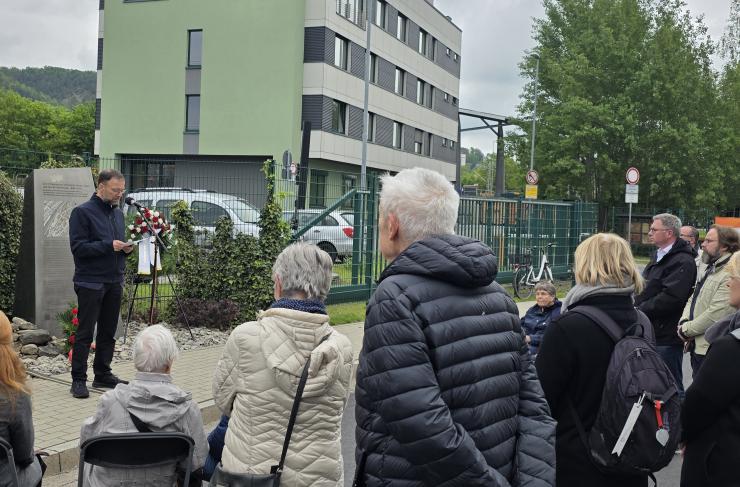
Gedenken an das Kriegsende 1945 vor der Gedenkstele in der Löbstedter Straße
© Stadt Jena
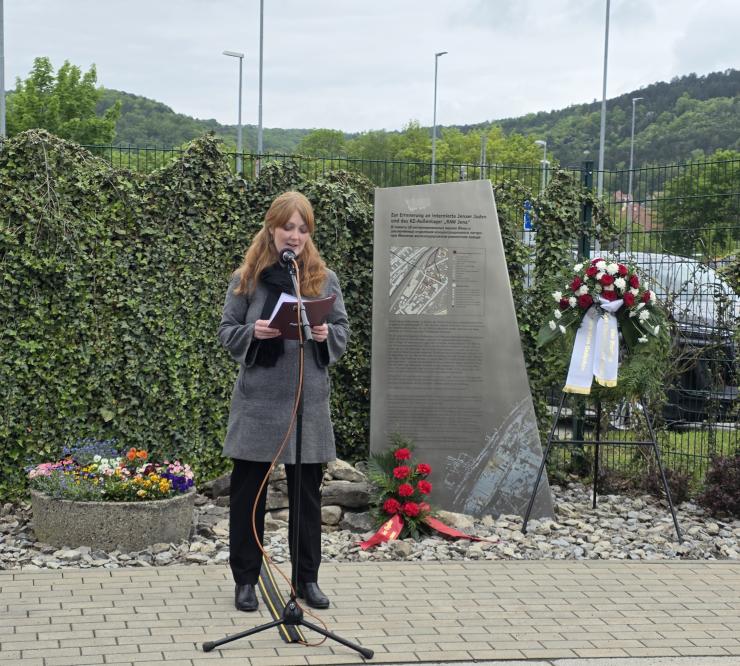
Stadthistorikerin Dr. Jenny Price hielt eine Rede zum Gedenken an das Ende der nationalsozialistischen Gewaltherrschaft.
© Stadt Jena