

The City of Jena Welcomes Its New Residents
The city of Jena once again held a ceremony to welcome new citizens. 304 people who were naturalized in the first half of 2026 were invited to the event in the City Hall foyer. Of these, 142 are women and 162 are men. Following “the formal, often lengthy and difficult naturalization processes,” Mayor Dr. Thomas Nitzsche extended a very warm welcome to them. With 200 people in attendance, the City Hall foyer was more packed than ever before at a naturalization ceremony in Jena. This demonstrates the great personal significance the ceremony holds for the new citizens and their families.
Those naturalized in recent months come from 49 different countries across five continents. The countries of origin with the largest numbers of naturalized citizens are Syria, Belarus, Russia, and Ukraine. In addition, ten stateless individuals were naturalized.
“Germany needs an influx of people because—despite digitalization and automation—people will always remain the foundation of the country’s economic strength,” Nitzsche emphasized. This is particularly evident in Jena, an economically strong city. “By the end of the decade, about one-third of the workforce will retire, but only one-third of them can be replaced by young people from here,” said the mayor. The shortage of skilled workers is being felt everywhere. However, he also acknowledged that many people have come to Germany seeking protection and asylum. Those who have now been naturalized have integrated very well—a process that usually happens quietly and does not dominate media coverage.
The number of naturalizations has risen sharply in recent years. While around 30 people were naturalized in Jena each year until 2010, that number had already risen to about 50 eight to ten years ago. Since 2018, the number has been over 70. In 2023, more than 200 people were naturalized, and in 2024, a total of 333. In 2025, a total of 564 people were granted German citizenship.
Whether it’s fleeing persecution, seeking work, or perhaps a relationship with a loved one—every naturalization is linked to deeply personal motivations, life stories, fates, and profound changes for each and every individual, said Nitzsche. The requirements for obtaining German citizenship include, in addition to lawful residence for at least five years in most cases, sufficient knowledge of German, a successfully passed naturalization test on the German legal and social order, a commitment to the free democratic basic order, and the ability to support oneself without social assistance or unemployment benefits. “I would like to express my sincere and deep appreciation for your effort, patience, and perseverance, as well as your courage,” said Nitzsche. “May you find a home here—if you haven’t already.”
Several naturalized citizens shared their experiences in brief speeches: Özgür Kaytancioglu from Turkey, Oana Glaessel from Romania, and Anne Jeannin from France.
MIG e.V. organized the cultural program. As an association with about 120 members, it brings together various ethnic groups, primarily from Eastern Europe, and is committed to the peaceful coexistence of people from different cultures.
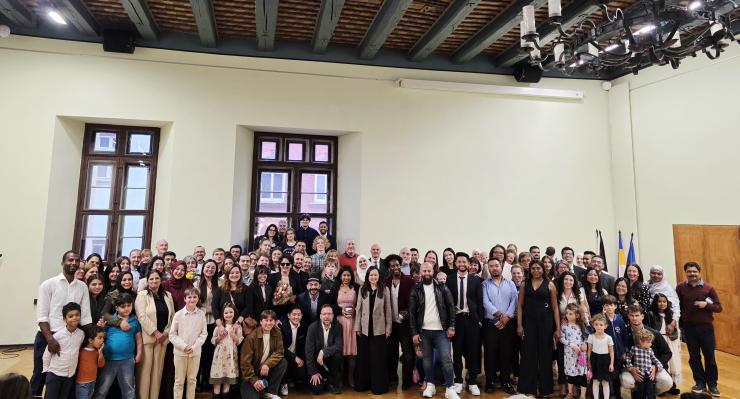
Die Stadt Jena heißt insgesamt 304 Menschen aus 49 Nationen als neu Eingebürgerte in der Stadt.
© Stadt Jena
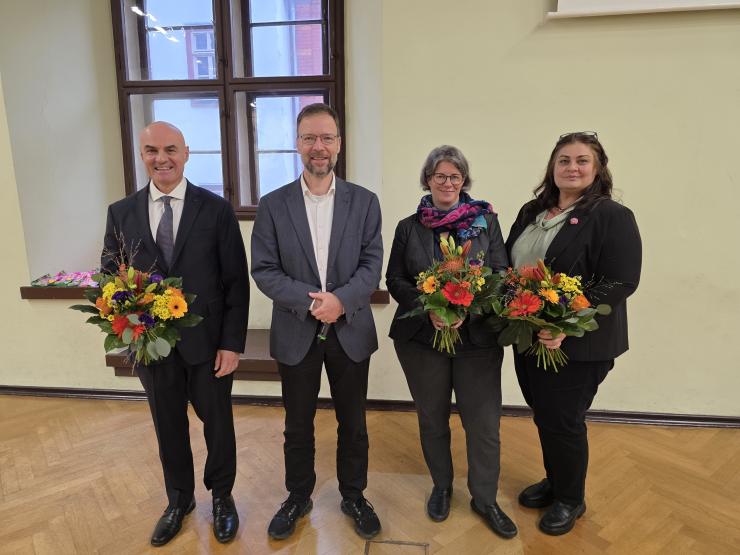
Mehrere Eingebürgerte berichteten in kurzen Reden von ihren Erfahrungen: Özgür Kaytancioglu aus der Türkei (links), Oana Glaessel aus Rumänien (rechts) und Anne Jeannin aus Frankreich.
© Stadt Jena