

Commemoration of the death march through Jena and naming of the Robert Büchler Way
The speech by Lord Mayor Thomas Nitzsche:
Dear Mr. Noack, thank you very much for your welcome,
Dear Prof. Wagner,
Dr. Rug, dear members of the Working Group Speaking Past,
dear Ruthi and Seadia, dear Yossi,
dear Omer, Roee and Tal,
Ladies and Gentlemen,
In recent years, we have been increasingly concerned with the question of how the memory and commemoration of the crimes of National Socialism can be kept alive when there are fewer and fewer contemporary witnesses of that time alive, and in the foreseeable future there will be none. No one will be able to answer this question conclusively.
Rather, we will always be faced with the challenge of not only not forgetting what happened back then, but also keeping the knowledge of it alive so that it remains a reminder to us. So that the crimes of National Socialism are not repeated.
It seems important to me that we succeed not only in reaching as many people as possible with this knowledge, but also in touching them emotionally.
If we succeed in touching people emotionally with remembrance - in very different forms - so that the suffering inflicted becomes not only understandable, but also comprehensible and tangible, then I am hopeful that we will not only say, "This must not happen again!", but that our society will also be able to say, "This will not happen again!".
The events surrounding the 80th anniversary of the liberation of the Buchenwald concentration camp last weekend were very moving, especially due to the presence of contemporary witnesses and relatives of contemporary witnesses who have since died, the second witnesses.
I am extremely grateful that our commemoration today is also enriched by your presence, Ruthi and Yossi. It is by no means a matter of course that you - like your father Robert Büchler - are reaching out your hand of reconciliation to us. Because we know very well that the trauma of the Holocaust continues to have an impact for generations.
Our conversations, dear Ruthi, about your father, about his suffering and above all about his life afterwards in the kibbutz in Israel, his later coming to terms with his own history and that of the children's block 66 and his great commitment to reconciliation here in Jena always touch me deeply.
Despite the unimaginable suffering that Robert Büchler had to go through, he remained unbroken, he was a person rich in interests, with great warmth and a lot of humor. A great role model.
I am very pleased that we are celebrating today's commemoration here together and that we will also be naming a street after Robert Büchler later on.
I would like to thank the Working Group Speaking Past led by Wolfgang Rug and Till Noack for being so involved in the preparation and implementation of our commemoration this year and for involving so many other people. Thank you very much!
The death march through Jena was the last major Nazi crime in this city. The following day, Jena was liberated by the Americans. For Robert Büchler, the death march through Jena was a horrific event, as it was for thousands of other prisoners. His liberation a few kilometers from here and his return here were and are a stroke of luck for our city.
Note:
Ruthi, Seadia, Yossi (Yossef) are the children of Robert Büchler and Omer, Roee and Tal are his grandchildren.
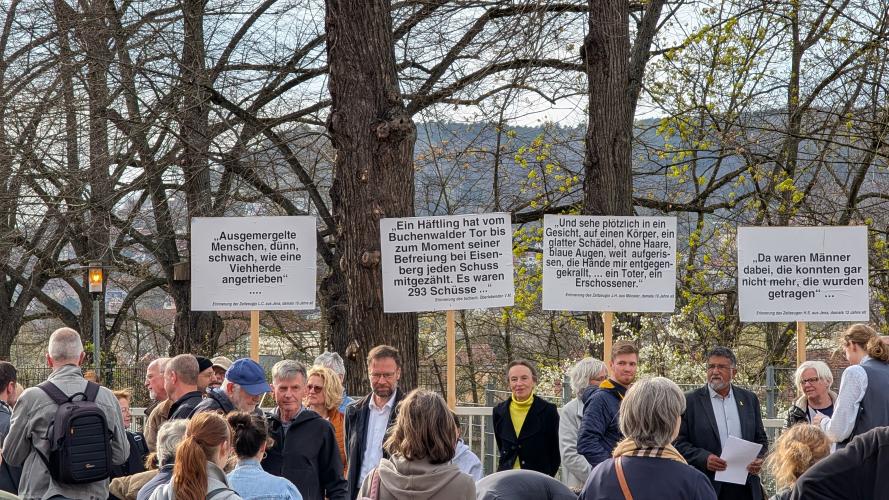
childer zeigen Berichte von Zeitzeuginnen des Todesmarsches durch Jena.
© Stadt Jena

Gedenken an den Todesmarsch durch Jena vor 80 Jahren (11. April 1945)
© Stadt Jena

Gedenkkranz der Stadt Jena und des Jenaer Stadtrates
© Stadt Jena
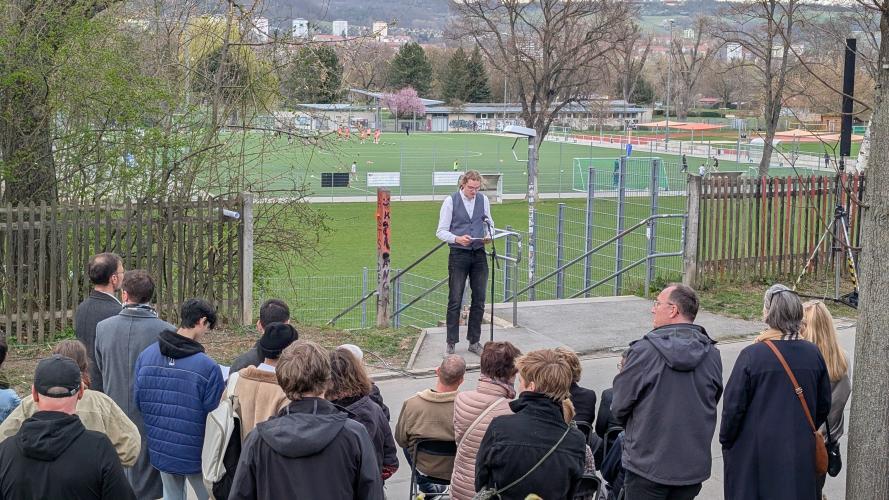
Während des NS-Regimes befand sich am Robert-Büchler-Weg in Wenigenjena, auf dem heutigen Sportplatz, ein Arbeitslager.
© Stadt Jena

Die Kinder von Robert Büchler enthüllen gemeinsam mit Ortsteilbürgermeister Bastian Stein das neue Straßenschild.
© Stadt Jena

Am neu enthüllten Straßenschild: Kinder und Enkel von Robert Büchler.
© Stadt Jena


