

Not everything that spins is an oak processionary moth
As soon as large webs appear on trees, the city of Jena receives concerned reports of a possible infestation with the oak processionary moth. But the all-clear has been given: the most recently reported cases in Jena are not the harmful pest, but harmless web moths.
The oak processionary moth is a species of moth whose caterpillars are mainly found on oak trees in the summer months, sometimes also on hornbeams. The species is known for its fine stinging hairs. These can cause skin irritation, itching, swelling and respiratory problems in humans. In individual cases, severe allergic reactions or asthma attacks are also possible. For this reason, the caterpillars and their nests should not be touched.
Harmless gypsy moths instead of oak processionary moths
However, there is currently no cause for concern: according to current knowledge, no occurrences of the oak processionary moth have been detected in Jena or the surrounding area.
Instead, the reported spider webs originate from gypsy moths. Their caterpillars cover shrubs and trees with conspicuous white webs, which often lead to confusion. However, unlike the oak processionary moth, gypsy moths are harmless to humans. They have no stinging hairs and pose no health risk.
Even if the spun-in plants appear severely damaged at first glance, they usually recover. The webworm moths are a natural part of the native fauna and do not usually cause any permanent damage.
Simple differentiation of the species
The city therefore asks citizens not to prematurely assume an infestation by the oak processionary moth if they see conspicuous webs. It is easy to recognize which of the two species is involved.
Caterpillars of the oak processionary moth have the following characteristics:
- dark basic coloration
- light, conspicuously long hairs and short, velvety brown stinging hairs
- body length up to 4 cm
- Mass appearance in "processions": migrations in long chains
- webs on broad trunks, especially of oaks, not covering the entire plant
The caterpillars of the harmless web moths can be recognized by
- light, yellowish basic coloration, dark spots
- no hairs
- body length up to 2 cm
- typical abseiling of individual or several caterpillars on long threads
- webs often cover entire plants
If you are unsure, you can continue to report observations to the relevant authorities.
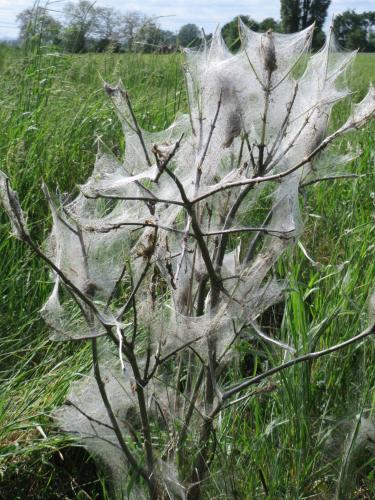
Gespinst einer Gespinstmotte
© AnRo0002 (CC0 1.0)
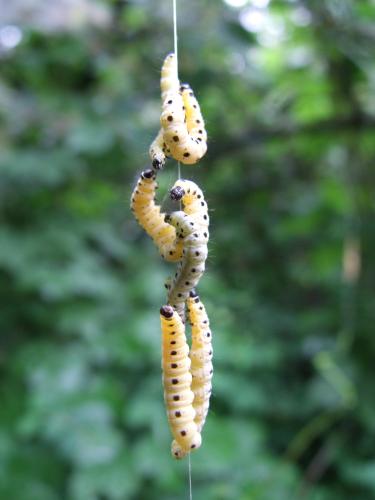
Raupen der Gespinstmotte
© An-d (CC BY-SA 3.0)
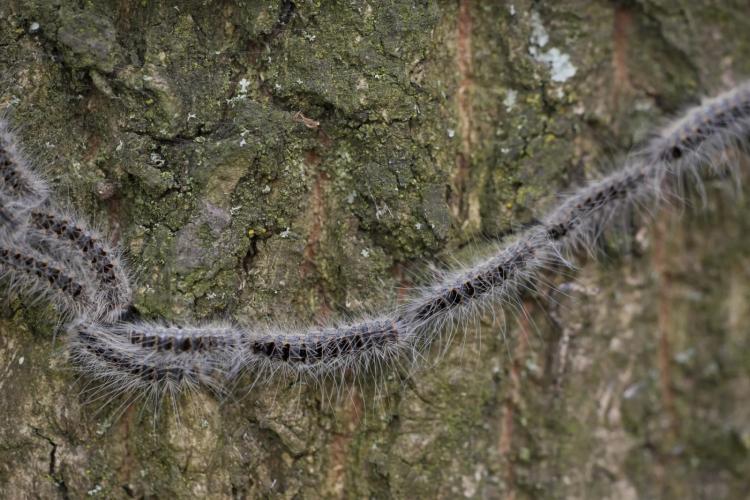
Eichenprozessionsspinner
© Luc Hoogenstein (CC BY-SA)


