

Real-world laboratory for the energy transition JenErgieReal starts construction work on site
The JenErgieReal research project is getting concrete: the real-world laboratory of the energy transition is starting to be built on site. Investments in Jena and the Saale-Holzland district are planned for this year and next.
Christian Dornack from Stadtwerke Jena Netze, Susanne Lippmann from jenawohnen, Lars Liebe from the city of Jena and social researcher Prof. Ulrich Lakemann provided information on the initial project results of JenErgieReal and the next steps at a press conference today (March 27, 2026).
Plans include the construction of battery storage facilities in Göschwitz and Drackendorf, the installation of electric charging stations in the city center, in the western district and in Winzerla as well as the use of innovative equipment for the supply of electricity and district heating. The components mentioned are to be digitally networked and intelligently controlled depending on the situation on the electricity market.
Exhibition "ENERGY - WHAT MOVES US"
The exhibition "ENERGY - WHAT MOVES US", which can be experienced at various locations in Jena, provides insights into the project work of JenErgieReal. In addition to a platform at Engelplatz and information steles at eight innovation locations, the EnergyLab at Löbderstraße 6 will open its doors on April 1, 2026. In the central showroom, findings and innovations from the real-world laboratory will be vividly presented, the background to the energy transition explained and concrete opportunities to help shape it demonstrated.
Real-world laboratory of the energy transition
JenErgieReal is a real-world laboratory for the energy transition funded by the Federal Ministry for Economic Affairs and Energy. It develops and tests solutions on how the energy transition in cities can succeed in a needs-based and cost-effective manner.
The interdisciplinary research project addresses the topic on several levels.
- Buildings and apartments: In a model district on Salvador-Allende-Platz in Lobeda-Ost, the project partners are testing intelligent solutions for the provision of heating and hot water. The aim is to optimize energy consumption in order to reduce CO2 emissions and stabilize operating costs for tenants.
- Urban supply grid: In order to avoid overloads in the electricity grid, energy supply and demand are to be intelligently coordinated. A virtual power plant is planned for this purpose. Generators, consumers and storage facilities for electricity and heat will be digitally networked and made controllable.
- Social research: The project will be accompanied by extensive social research into the acceptance of the energy transition.
- Participation: The exhibition "ENERGY - WHAT MOVES US" provides information on aspects and challenges of the energy transition, on the initial results of the project work and invites visitors to help shape the energy transition themselves.
Interdisciplinary joint project JenErgieReal
Stadtwerke Jena Netze, Stadtwerke Energie Jena-Pößneck, jenawohnen, Westsächsische Hochschule Zwickau, Ernst-Abbe-Hochschule Jena, the City of Jena, AWO Mitte-West-Thüringen and BRUNATA-METRONA are involved in the interdisciplinary joint project JenErgieReal.
JenErgieReal initially began with theoretical considerations and feasibility studies in 2022. Construction work on the renovation of the Salvador-Allende-Platz model district began in October 2023, and the actual implementation of the virtual power plant will now begin this year. The project should be completed by fall 2027. The real-world laboratory comprises a project volume for research and investment of 40 million euros, 20 million euros of which will come from federal funding.
Topics and focal points in the JenErgieReal project
The energy transition in everyday life: what do people in Jena think?
As part of JenErgieReal, Ernst Abbe University conducted a broad-based survey of the Jena population in 2024, in which 2,045 people took part. Apart from a few deviations, the sample provided a representative cross-section of the Jena population, reports social researcher emeritus Prof. Dr. Ulrich Lakemann.
The survey of the people of Jena revealed the following results:
- 69 percent are very worried/very worried about the consequences of climate change
- 42 percent expect neither advantages nor disadvantages for themselves personally from the energy transition, 35 percent expect disadvantages and 23 percent expect advantages.
- 72% consider it important/very important that electricity and heat are generated in an environmentally friendly way
- People tend not to fear bottlenecks in the electricity supply: 53% mostly disagreed/not at all agreed with this statement
- People pay attention to economical electricity (84%) and heat consumption (86%) (completely/mostly agree)
- 70 percent use low-consumption appliances or consciously switch off appliances to save electricity (mostly/completely agree)
- 38% limit their comfort in order to save energy (completely/mostly agree), 31% are willing to do so to some extent, 31% also mostly not/not at all
- 49% of respondents have a great/very great interest in new technologies for energy consumption and energy supply in the household (heating, hot water, electricity)
Energy transition in buildings: model district at Salvador-Allende-Platz
The prefabricated building complex at Salvador-Allende-Platz 9 to 23 in Lobeda-Ost has been undergoing extensive refurbishment since 2023. A total of 292 apartments with one to six rooms in the rent-controlled segment will be built here by the beginning of 2028. The first construction phases have been completed and the first tenants have moved in.
The buildings serve as a model district for JenErgieReal, in which new technologies for a climate-friendly and affordable energy supply are being tested in everyday life. The aim is to make the supply of heat and hot water more efficient, reduce energy consumption and cut CO2 emissions, explains Susanne Lippmann, Head of Technical Management at jenawohnen.
The following intelligent components are installed in the model district:
-
Building supply:
- An intelligent house connection station (iHAST) dynamically adjusts the district heating supply from the public grid to the actual demand in the building.
- A heat pump uses the waste heat from cooling the drinking water for heating and hot water - controlled by the iHAST.
- A heat pump uses the waste heat from the tenants' waste water for heating and hot water - controlled by the iHAST.
-
Apartment equipment:
- A digital heating control system helps tenants to reduce their heat consumption.
- Intelligent heat cost allocators and digital actuators on the radiators adjust the heat consumption of the apartment to the current demand.
- Smart window handles incorporate the tenants' ventilation behavior into the heating control system.
- Photovoltaic systems on the balconies allow tenants to use the solar power generated directly.
Energy transition for the grids: Intelligent equipment and virtual power plant
With the move away from fossil fuels such as gas and petrol, electricity is increasingly being used for heating (heat pumps) and driving (electric cars). As a result, the overall demand for electricity is rising. Above all, however, the power demand in the electricity grid is changing and multiple, constantly new peak load times are emerging: Essentially when people are at home, want to heat their homes and charge their cars.
At the same time, electricity is increasingly being generated decentrally and from renewable energies (wind, solar), which are available with temporal and seasonal fluctuations. For example, a lot of solar power is fed into the grid at lunchtime when people are not at home and demand is low. Times of high demand and surplus electricity in the grid alternate in quick succession. Distribution grids must not only be designed for the withdrawal of energy, but also for its feed-in and transportation.
JenErgieReal wants to solve this fundamental challenge of the energy transition not through regular grid expansion, but through intelligent control, explains Christian Dornack, Head of Strategy at Stadtwerke Jena Netze.
The plan is to digitally network existing and newly constructed systems for the consumption, generation and storage of electricity and heat. Together, they form a virtual power plant that can be controlled in a technically and economically sensible way depending on the current situation in the electricity grid. The construction of the plants and the necessary infrastructure will begin this year. The virtual power plant is scheduled to start trial operation for selected applications by fall 2027.
The following energy plants will be set up in Jena and the Saale-Holzland district:
- Ten charging stations for electric vehicles with different charging capacities - from lantern charging with an output of 3.7 kW to fast chargers with 200 kW.
The first systems are already in operation in Dornburger Straße/Schützenhofstraße, and further locations are being planned or are already being implemented. - Installation of a fast-charging station with battery buffer storage at Göschwitz station. Implementation is planned as part of the redesign of the station forecourt from fall 2026
- Construction of a district battery storage facility for the Drackendorf district. In view of the fluctuating electricity feed-ins and electricity requirements in the residential area, the storage facility is intended to relieve the grid and help maintain the quality of supply. Implementation is planned for 2027.
- Construction of a large-scale battery storage facility at the BürgerEnergie Jena solar park in Göritzberg in the Saale-Holzland district. The plant is intended to relieve the grid by feeding the generated solar power into the grid at different times. The staggered marketing of the solar power should lead to price advantages. Implementation is planned for 2027.
- Construction of battery storage systems for Jena's public transport system. It is conceivable that storage systems could be used to optimize energy consumption at the depot in Burgau and/or at the rectifier substations in the streetcar network. The concept phase is currently underway. Implementation can begin in 2027 at the earliest.
- Integration of four intelligent house connection stations (iHAST) for district heating into the virtual power plant. Implementation is already underway.
- Integration of three controllable local grid transformers (rONT) into the distribution grids of Göttern, Großlöbichau and Drackendorf (Am oberen Freiberg). In view of the fluctuating electricity feed-ins and electricity demand in the residential areas, these are intended to relieve the grid. Implementation from mid-2026.
- Development of a digital infrastructure that brings all these components together and makes them controllable in the form of a virtual power plant. A data hub receives real-time and forecast data, e.g. on the utilization of the electricity grid and the respective plants, weather forecasts and energy exchange prices. It derives control commands for the integrated components and sends them to the systems.
Understanding and shaping the energy transition: EnergyLab in Löbderstrasse
The aim of the three-part exhibition "ENERGY - WHAT MOVES US" is to explain the opportunities and complex challenges of the energy transition and present them to people in an understandable way. After the platform on Engelplatz, the EnergyLab, the exhibition's central showroom , will also be open to visitors at Löbderstrasse 6 from Wednesday, April 1, 2026.
The exhibition makes the findings and innovative solutions from the JenErgieReal energy transition real laboratory visible and shows how the energy supply of the future is already taking shape in Jena today, explains Lars Liebe, Head of Urban Development at the City of Jena.
Innovative technologies are clearly presented in the EnergyLab. Visitors can interactively explore how the intelligent control of systems for the generation, consumption and storage of electricity and heat can contribute to a sustainable energy supply. At the same time, the EnergyLab shows the background to the energy transition - from the development of energy use to the local climate effects in Jena and the added value of renewable energies for the environment and people. Visitors can also discover concrete ways to help shape the future: from reducing their own carbon footprint to exploring new professional fields and getting involved in society.
The "ENERGY - WHAT MOVES US" exhibition includes the following elements:
- EnergyLab at Löbderstraße 6
- Open Tuesday to Friday from 1 to 6 p.m. and during events
- Guided tours on Tuesdays and Thursdays at 3 p.m. and by appointment
- Platform at Engelplatz
- Open since mid-March
- freely accessible all year round
- Eight innovation locations in the city
- Steles with information texts and QR codes for in-depth content
- present the innovative energy solutions of the real-world laboratory on site (still under construction)
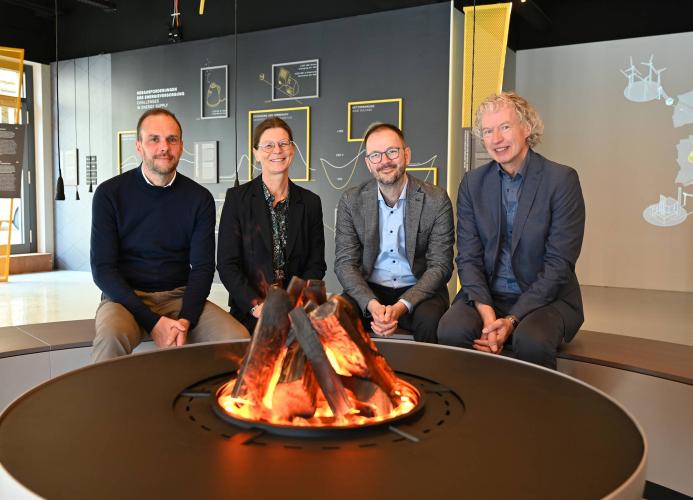
Auf die Eröffnung freuen sich Lars Liebe (Stadt Jena), Susanne Lippmann (jenawohnen), Christian Dornack (Stadtwerke Jena Netze) und Prof. Ulrich Lakemann (Ernst-Abbe-Hochschule, v.l.).
© Stadtwerke Jena / Heike Schmidt
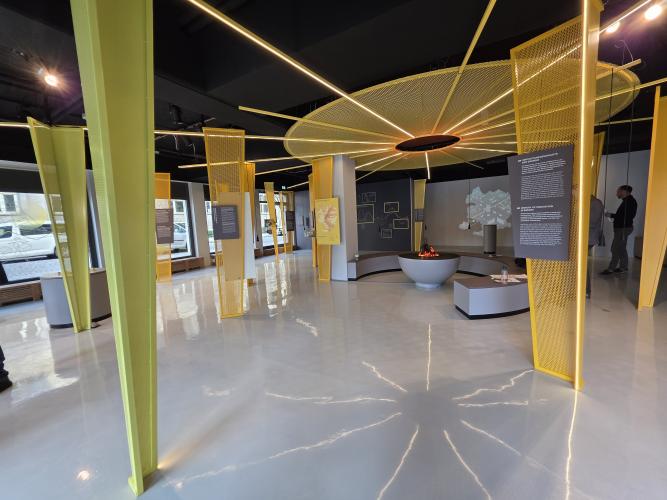
Blick in den Ausstellungsraum
© Stadt Jena

