

Two Years of JEDI and ProbierLaden
Digitalization requires more than just technology and digital applications. It also requires places where people can ask questions, try new things, learn from one another, and develop their own ideas. As part of his “Jena in Action” series, Mayor and Head of Digitalization Benjamin Koppe visited the ProbierLaden at Engelplatz on September 16 and then the JEDI at the Postcarrée.
Both facilities were established as part of the Jena Smart City project but are aimed at different target groups with the same approach: The ProbierLaden is run in cooperation with the Jena Adult Education Center and primarily supports people who have had little experience with digital technologies so far and wish to acquire basic digital skills. Through low-barrier programs, it helps break down reservations and enable digital participation. The JEDI, on the other hand, is aimed at people with existing digital knowledge—particularly professionals and stakeholders from government, business, academia, and the broader urban community. The focus is on education and continuing education, professional development, networking, innovation, and the development of new digital ideas. In this way, the two venues complement each other: from taking the first steps into the digital world to professional development and the collaborative design of digital solutions.
“Digital offerings must provide tangible benefits for people and work in everyday life. At the same time, we need places where people can find support, try out new things, share knowledge, and engage in dialogue with one another. This creates access to digital offerings, but also space for new ideas and developments. The ProbierLaden and JEDI each have different focuses and demonstrate just how diverse digital participation and digital development can be in our city,” says Mayor and Head of the Digitalization Department Benjamin Koppe.
ProbierLaden: Hands-On Digitalization
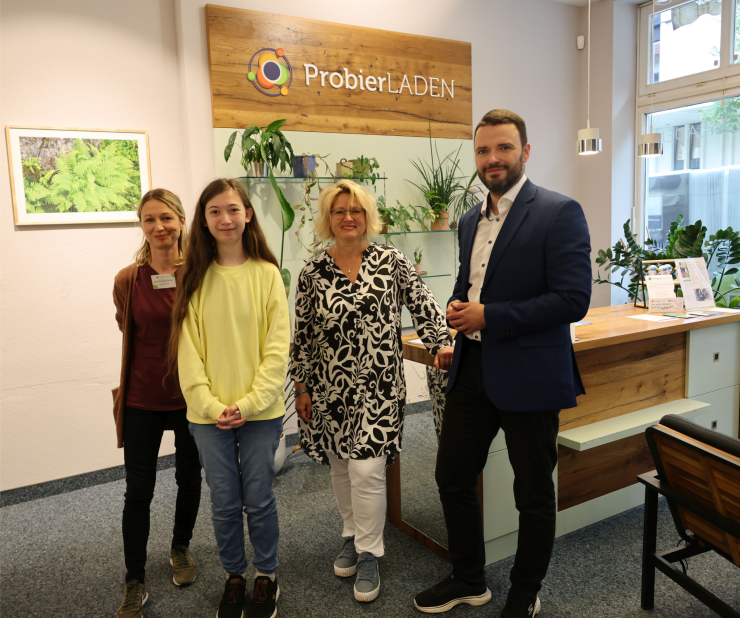
V. l.: Sara Delinger, Projektkoordinatorin „ProbierLaden“, Kira, FSJlerin im digitalen Bereich des ProbierLadens, Dr. Angela Anding , Leiterin der Volkshochschule Jena sowie Benjamin Koppe
© Stadt Jena
The first stop on the tour was the ProbierLaden on Engelplatz. On September 26, the center will celebrate its second anniversary. During this time, it has established itself as a low-threshold resource center for questions about smartphones, computers, apps, and digital applications.
As of September 7, the ProbierLaden had reached 6,979 people. The figures show just how great the need for low-threshold support is: 5,474 people took advantage of individual one-on-one consultations, while another 1,505 participated in educational offerings such as courses or informational evenings. An additional 740 people were reached through the ProbierMobil.
The need is particularly evident among older adults: About 79 percent of users are 66 years or older. Approximately 14 percent are in the 35-to-65 age group, and about seven percent are younger than 35. Younger visitors often use these services together with their families.
The topics covered in the consultations reflect everyday digital life: For older visitors, the focus is often on smartphones, apps, passwords and data security, online banking, or computers. Younger target groups are interested in topics such as smart devices, artificial intelligence, 3D printing, and media education.
In addition to individual counseling, the ProbierLaden offers a comprehensive educational program featuring a weekly PC Café, regular introductory courses, and two to three informational evenings per month on topics such as data protection, artificial intelligence, and the online ID. Additional offerings are developed based on current needs. To this end, the team collaborates with organizations such as the Consumer Advice Center, the police, citizen services, freelance media educators, and other providers.
“The high demand at the ProbierLaden shows that there is a concrete need for personal support with digital issues. New devices, apps, and digital services are evolving rapidly and aren’t equally intuitive for everyone. This makes low-barrier programs—where people can ask questions and receive practical assistance—all the more important. This helps people gain more confidence in using digital services and better navigate their digital daily lives,” said Koppe.
JEDI: Approximately 8,500 participants and a growing digital community
The tour then continued to JEDI—the Jena Digital Innovation Hub in the Postcarrée—which celebrated its second anniversary in August. JEDI is successfully operated as part of the Smart City project in collaboration with the Association for Digital Economy & Science Jena Digital e. V. While the ProbierLaden focuses on providing support for everyday digital life, JEDI brings together business, science, government, and the local community. The focus is on digital innovations, knowledge transfer, networking, and building digital skills.
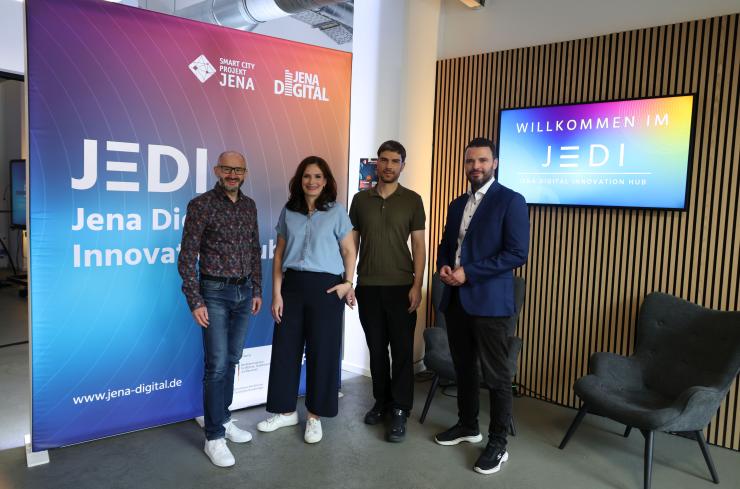
Im JEDI (v.l.): Georg Schmidinger, Netzwerkmanager de:hub, Dorothea Prell, Smart-City-Beauftragte und Gesamtprojektleiterin Smart City Jena, Domenique Dölz, Teilprojektleiter im Smart City Projekt und Clustermanager von Jena Digital e. V. , Benjamin Koppe
© Stadt Jena
Since its opening, approximately 300 events have taken place there, attracting around 8,500 participants (an average of about twelve per month). Topics range from smart cities, artificial intelligence, and software development to open source, cybersecurity, and extended reality, as well as startup founding and digital education.
High school and college students come into contact here with digital technologies, career paths, and companies. Professionals and companies use the space for exchange, continuing education, and networking. Startups gain access to networks, knowledge, and collaboration partners. Researchers contribute their research and new technologies to the dialogue with business and society. Government agencies and policymakers also use JEDI as a venue for dialogue, knowledge transfer, and the joint development of digital solutions.
Regular specialist groups, meetups, and event formats have also fostered a community that continuously uses and further develops the space.
External stakeholders also use JEDI for their own events and collaborations. These include, among others, Friedrich Schiller University Jena and Ernst Abbe University of Applied Sciences Jena, as well as local companies in the digital economy.
In terms of content, the community focuses in particular on issues relevant to the digital development of the city and the region: How can autonomous artificial intelligence be deployed in a concrete and responsible manner? How can new technologies and research findings be put into practice more quickly? How do these lead to new products, business models, and collaborations? And how can business, academia, government, and the city’s community work together to develop digital solutions that increase value creation in Jena?
Formats such as seminars for students, hackathons, Girls’ Day, and Code Week create opportunities for learning and experimentation. JEDI is thus not only a venue but also a meeting place and experimental space for Jena’s digital and innovation ecosystem.
“ProbierLaden and JEDI vividly demonstrate just how varied the approaches to digitalization can be. One venue focuses on very specific everyday issues, while the other focuses on education, innovation, and new ideas. For us, the two go hand in hand: digitalization must be understandable and accessible, but at the same time it must also create spaces where something new can emerge. As the funding phase draws to a close, it’s now increasingly important to take a close look: What has proven effective, where is there a lasting need, and how can successful approaches be continued in the future?” emphasizes Dorothea Prell, Smart City Coordinator and Overall Project Manager for Smart City Jena.
Two Locations, One Shared Approach
After approximately two years of operation each, both locations are simultaneously providing valuable insights for the further development of the Smart City project. The high usage rates, the diverse target groups, and the growing collaborations demonstrate which needs exist and which services are being embraced. These insights are now also being incorporated into discussions about which successful structures and formats can endure beyond the project’s duration.
Both facilities thus embody a central tenet of the Jena Smart City project: A digital city is not created solely through data, technical infrastructure, and new applications. It needs people who can understand, use, and help shape these developments—and physical spaces where people can meet, learn, and exchange ideas.
“The past two years have shown that both initiatives are well-received and meet a concrete need. Our goal is therefore to create opportunities so that successful structures like the ProbierLaden and the JEDI can continue beyond the funding phase. We are currently working hard on this,” says Mayor and Head of the Digitalization Department Benjamin Koppe.
As part of the “Jena in Action” series, Mayor Benjamin Koppe regularly visits institutions, projects, and key players who play an important role in the city’s functioning and further development. The focus is on direct dialogue with local residents and gaining insights into their daily work.