

What's Happening in Jena-Ost
Anyone who regularly spends time in the neighborhood not only gets to know the streets and squares, but over time also comes to understand the issues that concern the people there. That was exactly the focus of another stop on the “Jena im Einsatz” tour: Mayor and Head of the Security Department Benjamin Koppe, together with Sebastian Wick, Head of the Municipal Order Division, visited Community Liaison Officer Police Sergeant Jan Alberts in Wenigenjena. The focus was on his daily work, current issues in the neighborhood, and the collaboration between the police, the city, and the neighborhood.
Jan Alberts has been the community liaison officer for Jena-Ost since 2019. Previously, he worked on patrol. His current role differs significantly from traditional police operations. While patrol officers often respond to specific incidents, community policing relies primarily on a visible presence, local knowledge, and long-term relationships.
“It is precisely this proximity and the short lines of communication that are important. A community liaison officer knows the areas, is familiar with many of the recurring issues, and is personally approachable by the public. When the police, the neighborhood council, and the city share their observations and information with one another, issues can be identified early and often addressed more quickly. Safety isn’t just created when something has already happened, but also through a visible presence, dialogue, and reliability,” says Mayor Benjamin Koppe.
From his office on Schulstraße, Alberts covers his entire jurisdiction. In addition to Wenigenjena, this includes Wogau and Laasan, among other areas. The community liaison office offers regular office hours on Tuesdays from 3:00 to 5:00 p.m. Appointments are also available by arrangement.
Knowing What’s Going On in the Neighborhood
An important part of the work involves assessing the current situation. This is complemented by years of experience in police work and an understanding of where certain issues tend to arise repeatedly.
These often involve everyday concerns. In Jena-Ost, for example, issues related to traffic and traffic safety play an important role, especially near schools. The focus isn’t always immediately on issuing a citation. Often, situations can be resolved simply by speaking with the person involved and issuing a verbal warning. Where this is not sufficient, more extensive measures are also taken.
Another topic discussed during the joint walk was vandalism and illegal graffiti in the neighborhood. At several locations, the discussion focused on the options available to property owners to prevent damage and how to proceed in cases of recurring incidents.
During the tour, Koppe, Wick, and Alberts also spoke directly with residents. In addition to police and regulatory efforts, the discussion focused on practical ways to better protect one’s own property. Even simple measures on the building can help reduce opportunities for crime. These can include, for example, better lighting or technical solutions in the immediate vicinity of a house.
If perpetrators are identified, those affected should also consider whether to pursue their claims for compensation for the resulting damages through civil proceedings. Especially in cases of repeated damage, the goal is not only to document incidents but also to inform those affected about the options available to them.
“When it comes to vandalism and illegal graffiti, we see time and again that many small building blocks fit together. These include prevention, prompt reporting, and consistent prosecution. Our city’s strategy provides a solid foundation for this. But even simple measures taken on one’s own building can help reduce opportunities for crime. And when perpetrators are identified, I would like to encourage all those affected to pursue their claims for damages through civil law. It is important that property owners know what options they have and who they can turn to,” said Koppe.
Particularly noteworthy is the close connection to the neighborhood. Contact with the neighborhood council is firmly established. Specific reports and concerns are discussed, recorded, and followed up on together. The cooperation between the outreach unit and the Municipal Order Department is also rated as good by both sides.
During the visit, there was also an opportunity for a brief exchange with Bastian Stein, the district mayor of Wenigenjena, at the neighboring district office. The discussion focused on current issues in the neighborhood and on feedback conveyed to the police and city government based on the work of the district council.
A Visible Presence Builds Trust
Feedback from the public has been overwhelmingly positive. Community liaison officers deliberately maintain close contact with residents and are approachable for questions and reports. At the same time, they also support other police units during exceptional operational situations, such as large gatherings or demonstrations.
Video recording is now also part of their standard equipment. If it is used in conflict situations, those involved are informed. For the community liaison officers, it serves in particular to protect themselves. However, based on experience to date, this applies to far fewer situations than is often assumed.
Further Expanding Cooperation
The discussion also addressed the question of where the police and the city can work even more closely together in the future. One possibility is joint patrols or joint consultation hours involving community liaison officers and municipal public order authorities, wherever specific events or issues make this appropriate.
“Understandably, people don’t always distinguish in their daily lives which agency is responsible for which issue. What matters, however, is that their concerns are addressed and that the right agencies work together. That’s why we want to further strengthen cooperation between the police and municipal public order authorities. Joint patrols or consultation hours can be useful where there is a specific reason for them. Ultimately, what matters most are short lines of communication and reliable coordination,” says Koppe.
As part of the “Jena in Action” series, Mayor Benjamin Koppe regularly visits institutions, projects, and stakeholders that play an important role in public safety, citizen services, and the functioning of the city. The focus is on direct dialogue and identifying areas where cooperation can be further improved.
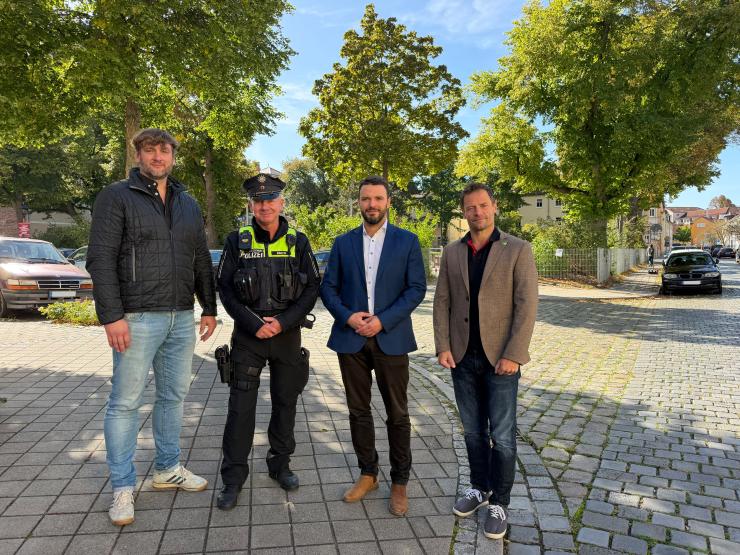
Bürgermeister Benjamin Koppe (2. von rechts) tauschte sich über aktuelle Themen in Wenigenjena aus (v. l.): Sebastian Wick, Fachdienstleiter Kommunale Ordnung, Kontaktbereichsbeamter Jan Alberts und Ortsteilbürgermeister Bastian Stein
© Stadt Jena